



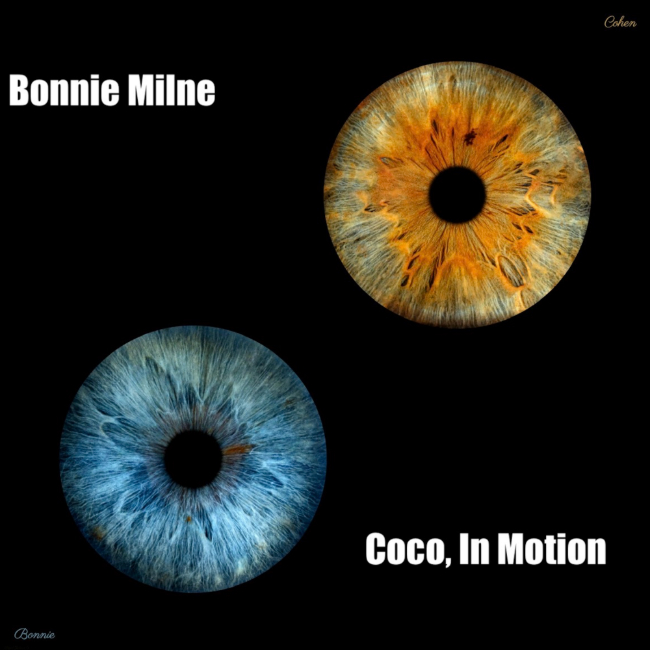
Music has always possessed a curious relationship with time. Unlike painting or sculpture, it cannot be experienced all at once. It unfolds, disappears, and survives only in memory, its meaning constantly revised by whatever comes next. For composers attempting to translate human experience into sound, this quality presents both a challenge and an opportunity. Bonnie Milne, the Canadian pianist and composer, makes that paradox central to “Coco In Motion,” a new instrumental work arriving October 30th on MTS Records.
The composition takes its inspiration from Milne’s eldest son, whose seemingly inexhaustible energy, beginning in childhood, suggested a life defined by perpetual movement. Rather than attempt a literal musical portrait, Milne constructs a shifting landscape of tempos, dynamics, and harmonic colors, allowing the rhythms of an individual existence to become the organizing principles of the music.
There is something distinctly modern about this approach, even as its foundations belong to a long tradition of instrumental storytelling. From Schumann’s miniature character studies to the impressionistic atmospheres of Debussy, composers have repeatedly sought to capture fleeting psychological states through changes in texture and harmony. Milne’s work participates in this tradition without appearing particularly concerned with announcing its historical credentials.
Her piano provides the composition’s structural foundation, but its role extends beyond melodic narration. Additional keyboard passages introduce countermelodies and harmonic movement, suggesting the simultaneous experiences that constitute a human life. A primary musical idea need not disappear when another emerges; the two may coexist, generating an impression of continuity amid change.
The instrumental ensemble is particularly intriguing. Cellist Kevin Fox supplies a darker, more resonant tonal presence, an expressive counterweight to the piano’s brightness. The cello, with its proximity to the human vocal range, has long served composers seeking to communicate emotions that resist verbal description.
More unusual is the inclusion of Adam Zimmerman’s soprano guitar, an instrument specially constructed for the performer by a classical guitar maker. Its delicate, silvery timbre introduces a contrasting register of intimacy. Where the cello suggests emotional gravity, the guitar offers something more fragile: the vulnerability that persists beneath even the most confident expressions of youth.
The recording process reflects a similarly intimate sensibility. Ross Love recorded Milne on his Shigeru piano, alongside Zimmerman’s performances, at his home studio in Orillia, Ontario. The material subsequently traveled to Adam Fair’s Villa Sound in Collingwood, where Fox’s cello was added and Fair completed the mixing.
The composition’s underlying conception is especially affecting because it resists the conventional tendency to represent childhood exclusively through innocence or nostalgia. Milne instead acknowledges its volatility. Motion becomes a metaphor not merely for activity but for the gradual accumulation of experience, with unexpected harmonic detours reflecting life’s resistance to orderly development.
One might hear in this premise an echo of a larger philosophical question: whether identity consists of a stable essence or an uninterrupted process of becoming. Milne’s answer, expressed through the interaction of instruments and changing musical gestures, appears to favor the latter.
Following “Glimpses,” her recent collaboration with Dave Hewitt, “Coco In Motion” extends Milne’s exploration of personal experience as the basis for contemporary instrumental composition.
The work’s most persuasive idea is also its simplest. A parent cannot preserve a child’s life by arresting its progress. Memory, however, offers another possibility: not stopping time, but giving its passage a recognizable shape.
In “Coco In Motion,” the act of composition becomes an act of attention. A mother observes a life unfolding, and music offers a way of keeping pace with it.