



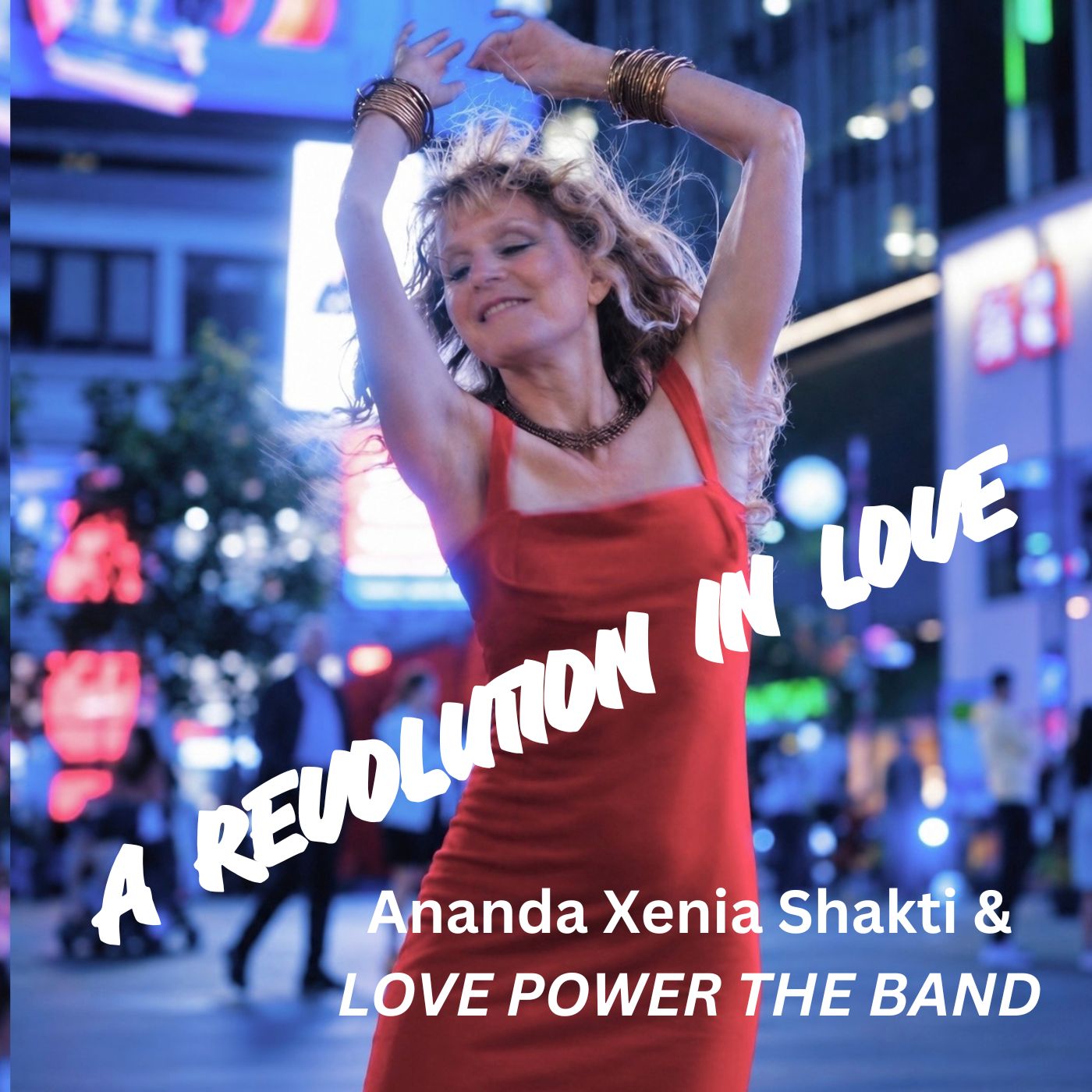
On her new Deep House single, the former punk rocker trades confrontation for compassion, discovering that electronic music can be as much about personal transformation as physical liberation.
Dance music has always promised transcendence. From the underground clubs of 1970s New York to the sprawling electronic festivals of the present, its central proposition has remained remarkably consistent: surrender to the rhythm, dissolve the boundaries between yourself and everyone around you, and experience something resembling freedom. Usually, the music leaves the interpretation to the listener. Ananda Xenia Shakti would rather start a conversation about it.
Her new single, “A Revolution in Love,” arriving November 6th on MTS Records, is an unusual proposition in contemporary Deep House: an extended spiritual meditation delivered through spoken word, built around an electronic framework, and concerned less with romantic desire than with the complicated business of being human.
For Shakti, this isn’t an unexpected philosophical detour. It’s the destination of a decades-long journey that began in Toronto’s punk underground, where she performed with The B-Girls, toured with The Clash, and participated in a musical culture defined by resistance to convention. Her subsequent embrace of Eastern spiritual traditions didn’t necessarily abandon that rebellious instinct. It redirected it.
The distinction matters because “A Revolution in Love” approaches spirituality with the conviction of someone who has experienced alienation rather than merely studied enlightenment.
Early in the song, Shakti acknowledges periods when human existence seemed devoid of kindness, meaning, or resolution. It’s a striking admission within a composition otherwise devoted to optimism. Her conception of love isn’t built upon avoiding suffering but upon recognizing what suffering can reveal.
“Being human is a revolution in love,” she declares, returning to the phrase as both thesis and affirmation.
Repetition is essential to the idea. In conventional dance music, recurring phrases become hooks, gradually shedding their literal meaning as they merge with the rhythm. Shakti attempts something different, using repetition to deepen a philosophical argument. Each return to the central declaration asks listeners to reconsider what initially sounds like an uncomplicated spiritual slogan.
The production, credited to Kabumi, Kudos Lokey, and Shakti, draws on an instrumental soundtrack connected to a remix of Keinemusik’s “The Day I Met You.” Its Deep House foundation provides a contemporary setting for lyrics that might otherwise belong to a guided meditation or spoken-word performance.
That combination is both the song’s defining quality and its artistic gamble.
Electronic music excels at communicating emotions that resist language. Shakti, conversely, is determined to articulate almost everything. She discusses suffering, freedom, interconnectedness, acceptance, and the possibility of radical love with little concern for conventional pop-song economy.
For listeners accustomed to concise vocal hooks, her expansive declarations may feel demanding. Yet that resistance to commercial simplicity gives the composition its identity. Shakti isn’t interested in reducing spiritual experience to something easily packaged.
The recording’s backstory provides an especially revealing dimension. Its original vocals were captured in one take during a collaboration that began in Costa Rica. After further development in India, the production returned to Toronto, where Shakti elected to preserve that initial performance.
The geographic circle mirrors the emotional one.
As a teenager, Shakti sought belonging on Toronto dance floors, long before she possessed the spiritual vocabulary to explain what she was searching for. Decades later, she has returned to electronic dance music with a different understanding of the same impulse.
The accompanying video’s return to the streets of her youth reinforces that reconciliation between rebellion and acceptance.
Ultimately, “A Revolution in Love” challenges the assumption that dance music must choose between intellectual ambition and emotional release. Its spiritual language won’t persuade everyone, nor does it need to.
What makes the project compelling is its insistence that the dance floor’s oldest promise—connection—might also be its most enduring purpose.
Shakti isn’t trying to escape the human experience through music. She’s trying to find a more generous way of inhabiting it.
And within a culture increasingly organized around division, that qualifies as a meaningful kind of rebellion.
“A Revolution in Love” will be released November 6, 2026, via MTS Records.