



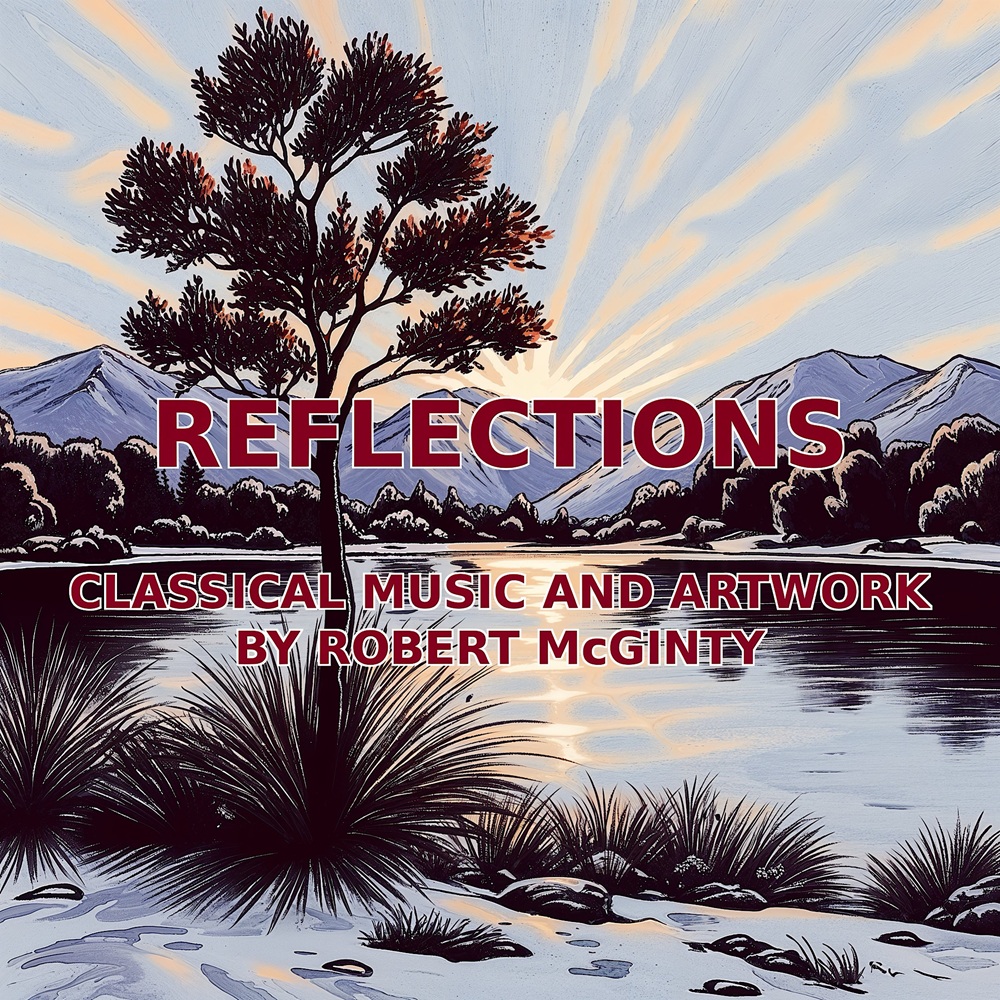
Typically, I notice that the releases from contemporary classical artists are often influenced by a particular legendary composer. However, I was truly impressed by “Reflections” by Robert McGinty, as it embraces a variety of inspirations from renowned classical composers.
The allure of classical music, in my opinion, lies in its ability to provide listeners with the space to envision and experience the narrative conveyed through the melodies. What I find particularly beautiful is that each person’s interpretation of the story can vary greatly. In this context, the piano takes center stage as the true maestro. I adore how each piece is so melodic, effortlessly evoking a wide range of emotions—one track can bring you to tears, while another can uplift your spirits.
The songwriting in this piece is truly exceptional; I was captivated by its smoothness. While I’ve explored several modern classical releases this year, many seemed to lack depth. In contrast, Robert McGinty’s “Reflections” felt like sailing on an ocean of endless waves, each one guiding me through different phases of my life. It’s a true masterpiece.
As you delve further into the album, you’ll find that the violins create a stunning harmony when paired with the piano. For instance, in “Ballade A L’Amour,” it feels as though he seamlessly blends traditional and contemporary styles, achieving a perfect fusion.
As McGinty pointed out, the music draws inspiration from a variety of artists. However, I concur that the primary influences are the remarkable Vivaldi and Joseph Haydn. “I was inspired by classical works by Vivaldi and Joseph Haydn for the piano pieces, Scott Joplin and Liberace for The Ragtime Special with traditional syncopation at the start and more showtime feel at the end of the piece. I was asked to write a few of the tracks, Ebbing Tides and The Whimsical Waltz for a music ensemble comprising a flute player accompanied by a string quartet. I was inspired by classical Spanish guitar pieces for the guitar tracks.” – Robert McGinty explained.
For instance, the Italian maestro Vivaldi is renowned for his vibrant energy, striking contrasts, and vivid imagery, which often bring to life scenes of nature and deep emotions. His compositions are characterized by rapid violin passages, dynamic shifts, and a strong rhythmic drive, giving them a lively and expressive quality. In contrast, the Austrian icon Joseph Haydn is celebrated for his clarity, wit, and innovative structure, which have earned him the titles “Father of the Symphony” and “Father of the String Quartet.” I must say, while listening to Robert McGinty’s music, I felt as if I were experiencing the essence of both Vivaldi and Haydn in one! Isn’t that impressive?
Robert McGinty‘s “Reflections” is not just an album; it’s an invitation to embark on a musical journey that transcends time and genre. Each track is meticulously crafted, offering a rich tapestry of sounds that evoke a spectrum of emotions. I believe that when listeners dive into “Reflections” will discover a harmonious blend of past and present. The piano pieces, inspired by the likes of Vivaldi and Haydn, carry a sense of timeless elegance, while the Spanish guitar tracks infuse a vibrant and passionate energy. The Ragtime Special, influenced by the playful syncopations of Scott Joplin and the flamboyant flair of Liberace, adds a cheerful and lively contrast to the album.
Moreover, McGinty’s compositions for flute and strings showcase his ability to create lush, atmospheric soundscapes that transport the listener to different realms. The album’s diversity not only highlights Robert’s versatility as a composer but also his deep understanding and appreciation of musical traditions.
“Reflections” is poised to be a landmark in modern classical music, offering something for everyone—from the seasoned classical aficionado to the casual listener looking for something fresh and invigorating. Robert McGinty‘s unique approach ensures that “Reflections” will not only resonate with his existing fans but also captivate new audiences, solidifying his place as a leading figure in contemporary classical music.