



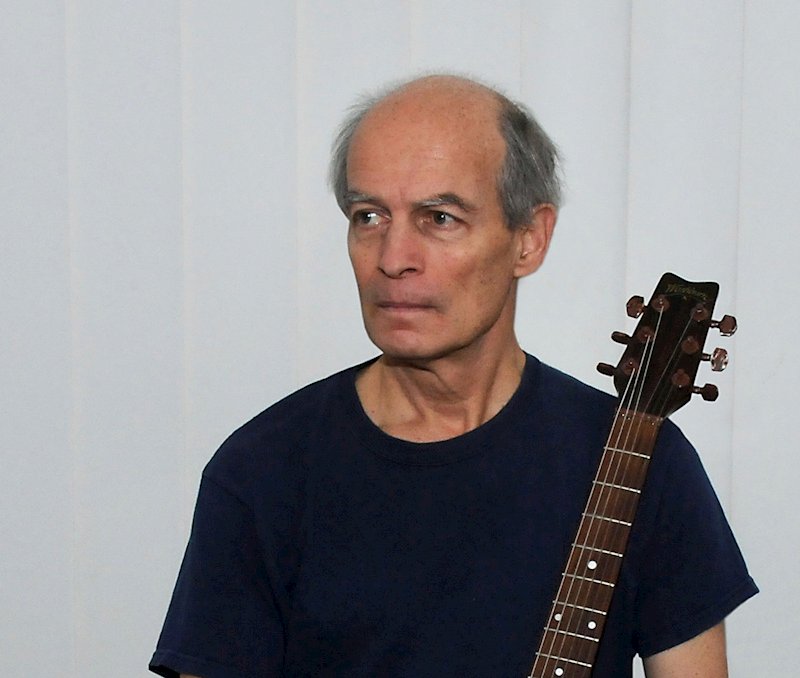
Alf Jetzer, a Swiss multi-instrumentalist and composer, has developed a unique style called “world music with spirit” over four decades. His music blends meditation, progressive rock, jazz, classical, and global elements into immersive compositions. Jetzer describes his process as “musical painting,” layering sounds from various instruments to create a deep sense of presence. His latest album, UNFOLDING, reflects this artistic journey, combining two years of intensive work and forty years of experience. In the following discussion, he shares insights on his evolution, the album’s details, and his future intentions.
- Over your forty-year musical journey, beginning with the clarinet at age eight and expanding to a diverse array of instruments, how has the integration of global and meditative influences shaped your evolution as a composer who prioritizes a high recognition value in each piece?
My musical career has been going on much longer. 40 years is the time span I’m focusing entirely on recording, establishing it it as a standalone art. Years before that, I started learning, playing and using instruments in bands and orchestra.
In my younger years, external influences played an important role, as my own experience was not yet established.
Over time, the focus shifted more and more inwardly. I began to reshape/adapt the skills I had acquired externally so that they ultimately became part of myself. It’s similar to learning a language.
Learning the language is the first step. The next step is to use the language according to your own predisposition.
So, every person has their own way of expressing themselves linguistically. This is the recognition value = you recognize the person immediately, purely by the way they speak. This includes not only how they put words together, but also the sound of their voice.
This can be applied one-to-one to (instrumental) music. Meditation greatly supports and deepens such processes.
It helps to express the essential even more and leave out the superfluous. In other words, it gives each note more significance and power (the energy behind the tone).
I subordinate everything to this aspect—it should be an listening experience from the very first note (giving you goosebumps).
I have learned how to proceed to ensure this quality. It takes a lot of time and patience. An open listener will immediately feel this in my music. A listener who is not fixated on one (his favoured) genre and ignores everything else. My compositions touch on different genres. That is why they are accessible to a “broad spectrum” of listeners.
- You describe your compositional process as “musical painting,” using instruments like colors to realize mental images. In what ways has this philosophy guided your self-contained approach to recording and production throughout your career?
It’s more the other way around: this approach was the origin and has determined the course of my recording career.
One of my preferred method of recording is: by not playing through an entire piece (an entire take) in one breath, but dividing everything into smaller sections, I am able to bring a high level of energy to each section (only recording it when I am in the “best” condition). This way, I manage to avoid any “slumps” = everything remains energetically in the upper range. This also applies to pauses = they are not “empty space,” but are also filled with energy. Pauses are important as well for making the following notes more expressive (the contrast between silence and sound). I use each instrument, its sound, and the phrases played like colors, which I combine into an “overall picture” after a dedicated process. Like a painting that gradually emerges. This requires a lot of time and patience. AI will never be able to achieve such results. There is no need to be concerned about the AI trend. AI-generated songs have no lasting effect. A piece with substance and depth, created by a real musician, lingers long after listening, whereas AI-generated music leaves nothing behind = it fizzles out immediately = it cannot create inner images because it lacks substance and depth.
- “UNFOLDING” is positioned as a high point in your oeuvre, incorporating two years of dedicated effort and forty years of accumulated experience. What specific challenges did you encounter in balancing its multi-genre elements—such as progressive rock, jazz, and world music—to achieve the album’s hypnotic and atypical arrangements?
There was a point in my musical life when I was no longer so concerned with reproducing genres “authentically,” but instead it became more important to me to manifest the spirit of each genre. Over the years (including the external genre influences of earlier years),
everything musical in me has merged into a single “language” with which I can reproduce the various genres impressionistically without having to declare them genre-authentic. It was and is more important for me to bring the immersive aspect into my creations, using the approach described above. So, for me, it’s not about genre authenticity, but about artist authenticity (which ultimately manifests itself in high recognizability).
- Given that each composition typically requires nearly two months of creation, how did the extended timeline for “UNFOLDING” allow you to infuse greater “soul” and vitality into the work, particularly through atmospheric instruments like singing bowls and the Armenian duduk?
The fact is that it takes time for an idea to mature and become so internalized that it becomes a kind of temporary purpose in your life. The initial idea thus becomes part of myself. Once this status has been achieved, spirit can be manifested with almost any instrument. Then only “techical” questions come to the fore: for example, should the instrument be able to play short or long notes? Should it have this or that sound character? Should it be percussive? Of course, you have to spend several years working with the instruments themselves beforehand so that they do what you expect them to do (that they can manifest the musician’s own expression). This is only possible if you become one with the instruments.
But what is also important is that you cannot compose an entire song without interruption. You need to take breaks of 2 or 3 days in order to hear objectively again.
And further: between each composition of UNFOLDING, I took a break of 2 weeks or more. The next piece was then created with a new consciousness = each piece embodies a new “mini-epoch.” As a result, it radiates something different from what came before.
- Your commitment to composing as a standalone art form, eschewing external pressures like commercial deals, has resulted in a unique, long-matured body of work. How does “UNFOLDING” exemplify this patience, and what insights from decades of meditation have informed its thematic depth of stillness and presence?
UNFOLDING is the culmination of a long journey, the destination of which I could only recognize toward the end.
I have made many recordings, but in retrospect, they were more like stopovers and preparations for the finale which is “UNFOLDING”. Although I also created these earlier pieces with great dedication.
It is a journey in which one strives to become better and clearer in one’s expression. Each tune is like a rung on a ladder. You need all the rungs to get to the top. Each tune has opened a new door for me to greater clarity. Meditation is the “glue” that holds it all together, bringing in subtlety and immersiveness. UNFOLDING is the manifested sum of the experience of everything (growth of my personality and my music).
- As you transition from a primarily introspective creative phase to sharing your music more broadly, what strategies are you considering for presenting “UNFOLDING” to audiences, such as through live adaptations or multimedia collaborations?
I can’t plan too far ahead. I’m someone who lives very much in the moment. I think promoting my creation will take place as the next step because at this time I don’t think that I can surpass “UNFOLDING” with another album. I am someone who cannot be satisfied with simply repeating something similar. The new must always surpass the previous.
Multimedia collaborations and other things may be a meaningful goal . However, there will be no live adaptations on my part. Recording has matured into an independent form of expression for me. The creations cannot be “outsourced” without loss.