



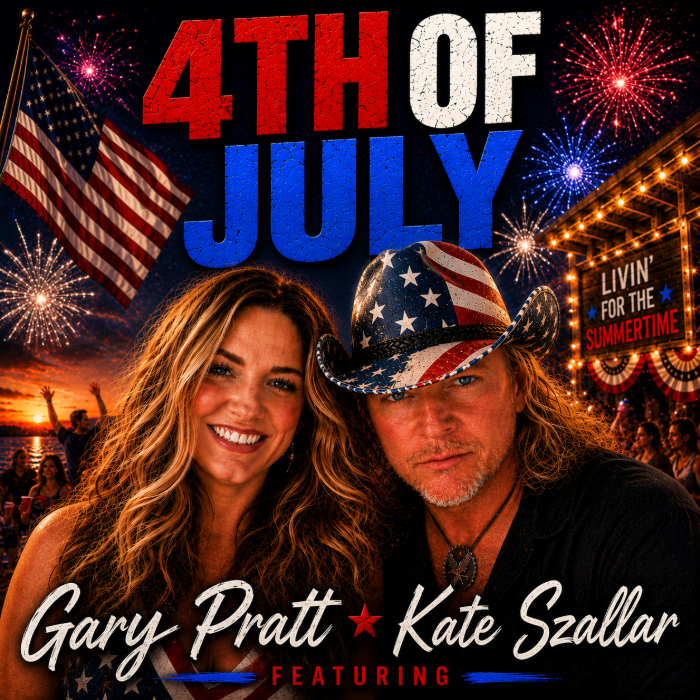
Country music has always had a peculiar relationship with American mythology. It borrows its symbols freely—small towns, highways, church pews, rivers, flags—and then quietly reshapes them into something far more personal. Gary Pratt’s “4th of July” performs exactly that kind of transformation. The title promises one national story, but the record delivers another entirely. It suggests that the country’s most celebrated holiday isn’t a date on the calendar at all. It’s a feeling that can happen any night, in any room, between any two people willing to surrender to it.
The song begins in February, a month that traditionally carries none of July’s promise. Winter is still lingering, routine has settled in, and the world outside seems ordinary. Yet the lyric immediately dismisses geography and season. The weather becomes irrelevant because the emotional temperature has already changed. By the chorus, Pratt has replaced civic celebration with private revelation. Fireworks no longer belong to the sky. They’ve been relocated indoors, becoming symbols of intimacy rather than spectacle.
That reversal is the song’s quiet triumph.
American popular music has often treated holidays as communal experiences, moments when individuals dissolve into crowds. Pratt moves in the opposite direction. The parade never arrives. There is no audience. There are only two people discovering that the most memorable celebrations often happen beyond public view. It’s a reminder that the mythology of America has always existed alongside the mythology of romance, each borrowing images from the other until the distinction begins to disappear.
Vocally, Pratt understands restraint. His performance refuses melodrama, choosing instead the confidence of someone who recognizes that conviction rarely requires volume. He doesn’t announce emotion; he inhabits it. The effect is persuasive because it never strains for significance. The lyric is allowed to find its own weight.
Kate Szallar’s contribution becomes essential rather than decorative. Her voice enters not as contrast but as completion, giving the song the conversational quality that romantic duets frequently seek but rarely achieve. Together they create the impression of shared memory rather than staged performance. The listener isn’t observing two singers; they’re overhearing two lives intersecting.
The production, guided by Adam Ernst, reflects similar discipline. Ernst, whose work includes recordings by Bailey Zimmerman, Mickey Guyton, and Chase Matthew, also performs every instrument on the track. That singular vision gives the arrangement remarkable cohesion. Nothing competes for attention. The guitars shimmer without insisting upon themselves, the rhythm moves with quiet certainty, and every musical choice reinforces the central metaphor rather than distracting from it.
Perhaps what lingers most is the song’s refusal to separate joy from everyday existence. The celebration requires no stadium, no fireworks display, no public declaration. It asks only that ordinary moments be recognized for their extraordinary potential. That idea has always been woven into the fabric of American songwriting, from front-porch ballads to modern country radio, and Pratt adds another thread to that tradition.
“4th of July” ultimately suggests that the grandest symbols endure because they remain open to reinterpretation. A national holiday becomes a love song. A fireworks display becomes a heartbeat. A familiar image becomes new again.
That is how songs survive. They don’t preserve symbols; they reinvent them. Gary Pratt’s latest single understands that, and in doing so, it quietly turns a well-worn piece of Americana into something unexpectedly intimate.
–Marcus Grey