



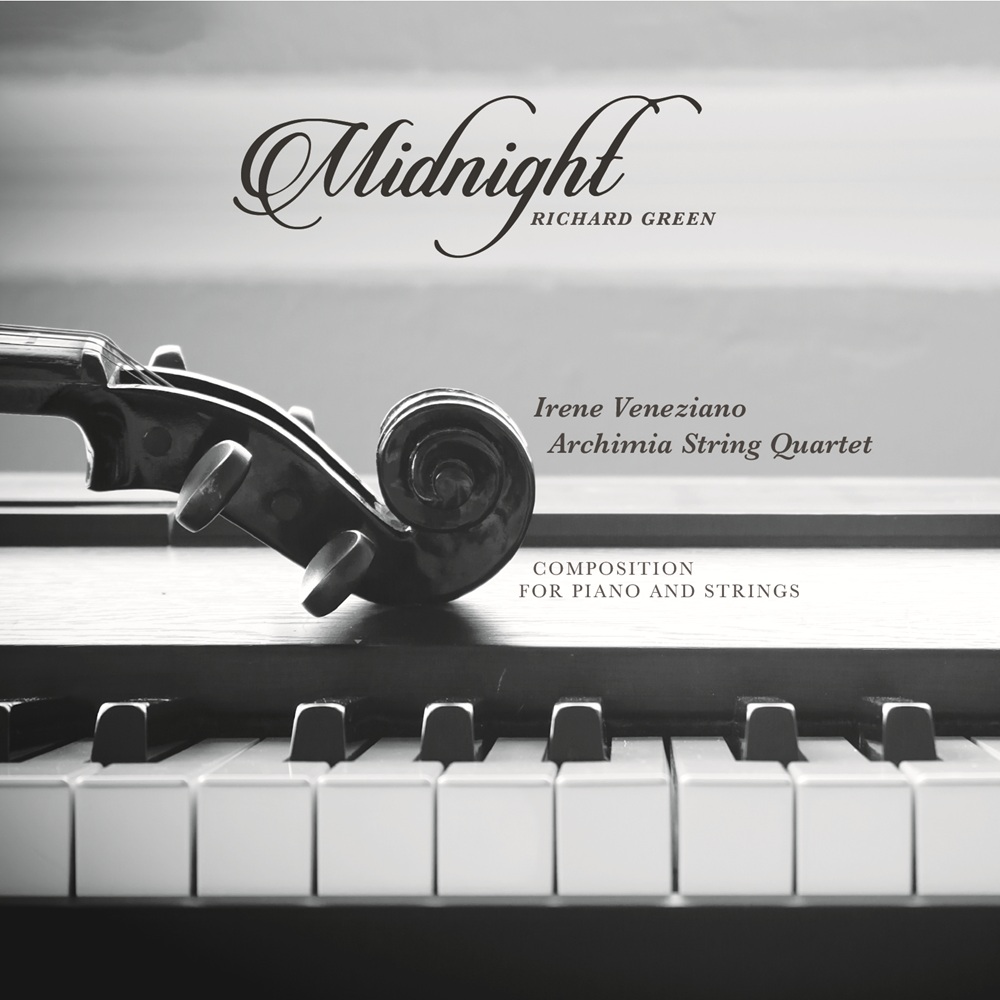
There is a quiet kind of precision in Midnight, the kind that doesn’t draw attention to itself, yet shapes everything you feel as you listen. Richard Green approaches the piece with a sense of patience, allowing it to unfold gradually, almost as if time itself is being stretched and observed rather than simply passed through.
The opening is understated, but not empty. The piano enters with clarity and restraint, each note placed with intention, leaving space around it. When the strings arrive, they don’t disrupt this stillness; they deepen it. There’s a sense of expansion, as if the music is slowly revealing its inner layers rather than presenting them all at once.
What’s striking is how the composition handles tension. It doesn’t rely on obvious climaxes. Instead, it leans into subtle harmonic shifts and slight deviations from expectation. The result is a quiet unease that feels deliberate, even necessary. You begin to sense that the piece is less about resolution and more about staying within the question.
As it develops, the dialogue between piano and strings becomes more fluid, more exploratory. There are moments where the harmony feels almost suspended, neither fully grounded nor entirely dissonant. This in-between space is where the piece seems most alive. It invites you to listen closely, not for answers, but for nuance.
A brief return to the piano alone creates a moment of inward focus, before the full arrangement re-enters with a subtle transformation. Nothing is dramatically altered, yet everything feels slightly shifted; more settled, but also more aware of its own fragility.
There’s also a quiet blending of influences at play. While the foundation is clearly neoclassical, there are gestures that echo beyond it, phrasing that hints at jazz, textures that feel almost cinematic. These elements are never overstated; they simply exist within the fabric of the piece, giving it a broader emotional range.
In Midnight, Richard Green seems less concerned with guiding the listener and more interested in creating a space where something can be experienced on its own terms. It’s a composition that trusts its own pacing, its own silences.
And by the time it fades, Midnight by Richard Green leaves behind not a conclusion, but a feeling: quiet, unresolved, and gently persistent, like a moment you didn’t realize mattered until it had already passed.