



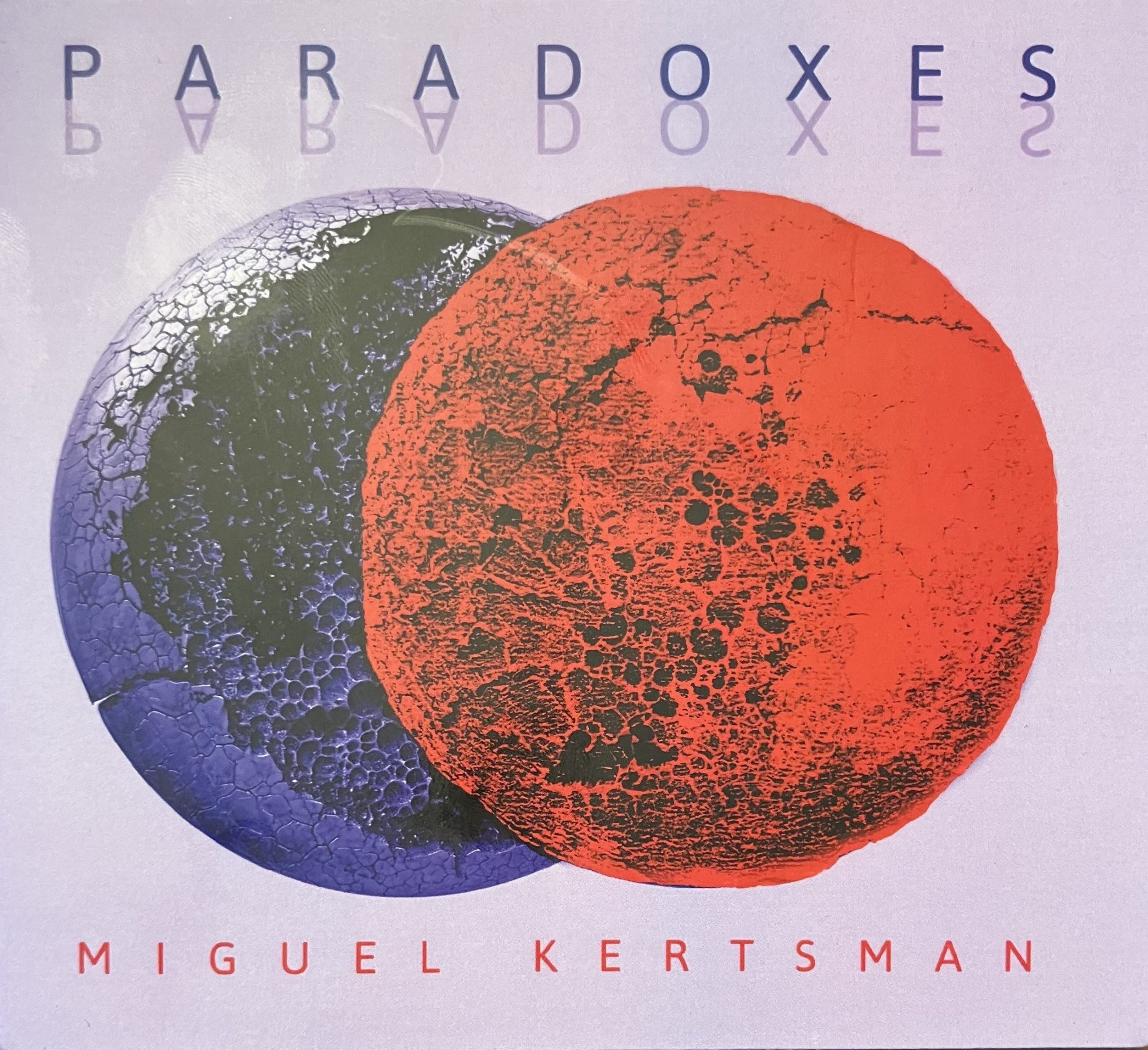
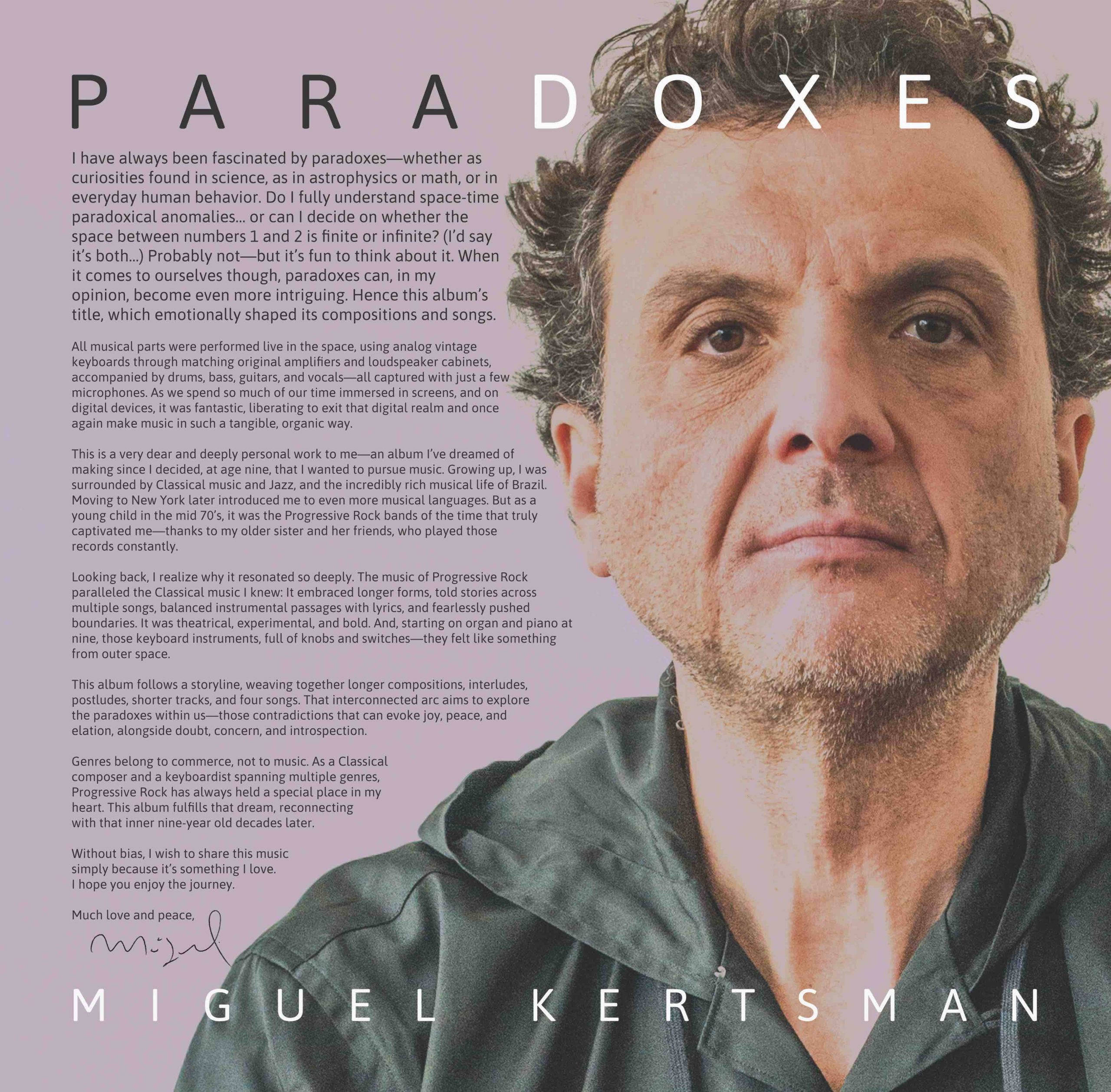
When a composer whose work has graced the London Philharmonic Orchestra, the Olympics, and countless video game soundscapes decides to return to the progressive rock that first ignited his musical passion, you know you’re in for something extraordinary. Miguel Kertsman‘s “Paradoxes” is that rare album, a sophisticated collision of European classical tradition, Brazilian folklore, and the vintage synthesizer-driven prog rock of Yes, Pink Floyd. This is a nutritious concept album that demands your full attention. It’s played entirely live on original vintage instruments whose warm, analog tones haven’t graced a record like this in decades.
Paradoxes are those beautiful contradictions found in astrophysics, mathematics, and human behavior itself. Kertsman weaves these themes throughout a narrative that contemplates our polarized world, our anxiety-ridden relationship with Spaceship Earth, and the fundamental mysteries of our existence. With Minimoogs, Mellotrons, and Prophet 10s, drums, bass, and guitars, Miguel Kerstman is more than equipped to tell a story of epic proportions. Let us dive deep into each movement of this meticulously crafted odyssey.
“Enclosed Pathways” sets the stage with its prolonged intro and haunting soundscapes to probe your imagination. Once the drums hit, though, you realize this isn’t just a ride in ambient psychedelia; no, this is much more. As the song’s unconventional structure unfolds, Kertsman’s vision becomes clear: To invite you to explore the pathways of your mind. But before you get lost at around the 4-minute mark, a funky groove is introduced, and we return to normalcy before crashing back to the atmospheric intro.
“Postlude: Letting Go” serves as a conclusion to the previous track. An open, honest, and raw outpouring of notes that is a foil to the mind-vexing journey of the song that precedes it and the one that follows.
“Still Currents” continues the album’s paradoxical naming convention, and Kertsman starts with the most intense and busy section at the helm. A driving and bombastic section with a memorable marching melody that fades away in under a minute to represent currents ceasing. There is some incredible sound design of waves and almost whale-like sounds floating in this section. We’re then gently guided back to the bombastic melody that we started with. A paradoxical cycle like the tide.
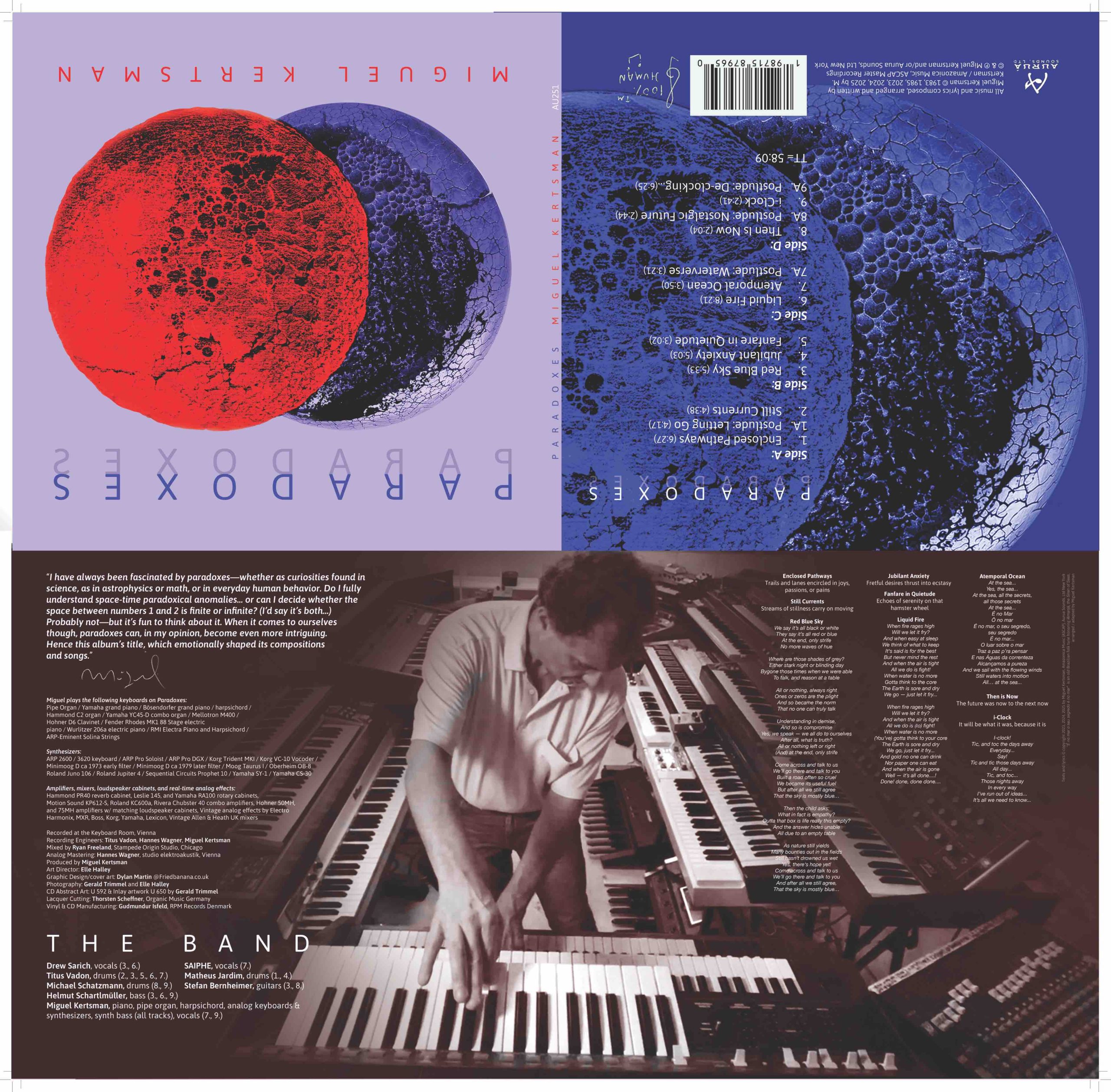
We arrive at the album’s first vocal song, “Red Blue Sky”. Its theme is about our increasing inability to engage in an honest discussion with one another and our futile attempts to divide and categorize things into two camps instead of trying to listen to each other and reach some common ground. The lyrics are an allusion to political division. Musically, this could be mistaken for a Pink Floyd song with how mellow the music is and how the song’s message is about unity, a la “Us and Them”
“Jubilant Anxiety” is the next song on the album. The song’s title is probably the most relatable paradox of them. This is the heaviest song so far, with so much dissonance baked in and that headbang-inducing main motif and groove. Speaking of groove, the drums on this track deserve some highlighting. Matheus Jardim delivers a really complex, nuanced performance here. As the song switches to Jazz/Fusion, the drums steal the show with complex passages switching to heavier ones seamlessly.
“Fanfare in Quietude” has less seamless transitions, but that’s the point of this song. This song has the most traditional classical arrangement of all the songs on the record. At its core, at least. If you strip away the interesting and varied texture choices, it’s simply a very powerful classical piece of music about celebrating the quiet moments in the loudest way possible.
“Liquid Fire” opens with a Tool-style riff that immediately grabs your attention. Kertsman’s environmentalist lyrics paint a picture of our planet’s precarious state, warning of the consequences when we ignore nature’s balance. Those heavy riffs represent the fire, but it never stays in one place for too long. Classical orchestration collides with ambient synth sections to create the liquid part of the song.
“Atemporal Ocean” is a dreamy masterpiece and features vocals from Miguel Kerstman and Loren (Saiphe) Kertsman. The lyrics flow between English and Portuguese as the harmony takes on a journey across an ocean stuck out of time, yet full of secrets. “Postlude: Waterverse” is the instrumental conclusion that feels like watching the tide recede. It works beautifully as a supplement to the dreaminess of the previous song.
“Then Is Now” and “Postlude: Nostalgic Future” have a space-age-flavored harmony that conveys the vastness of space-time. The endless possibilities that are yet to happen and that have already gone away at the same time. The instrumentation here is sparse and very carefully handpicked to paint enough of an image to probe your mind and leave you to contemplate what “Now” actually is.
“i-Clock” reminds me of the band Curved Air, with its groove that has an almost reggae quality to it. The creatively designed patches on those analogue synths color the sonic landscape, and just when you think you know where the song is headed, we get a drum break and a harpsichord solo! “Postlude: De-clocking” serves as both a conclusion to the previous track and its own journey. Miguel Kertsman takes us through oscillating sounds and varied dynamics, with synth textures that pulse and breathe like a living organism. The piece builds and recedes with surgical precision, serving as the perfect ending for this multifaceted experience.
Miguel Kertsman’s “Paradoxes” achieves that delicate balance between instrumental virtuosity and emotional storytelling. This is music for those who remember when albums were journeys, when synthesizers required actual hands-on performance, much like any physical instrument, and when prog rock visionaries fearlessly pushed every boundary they encountered.