



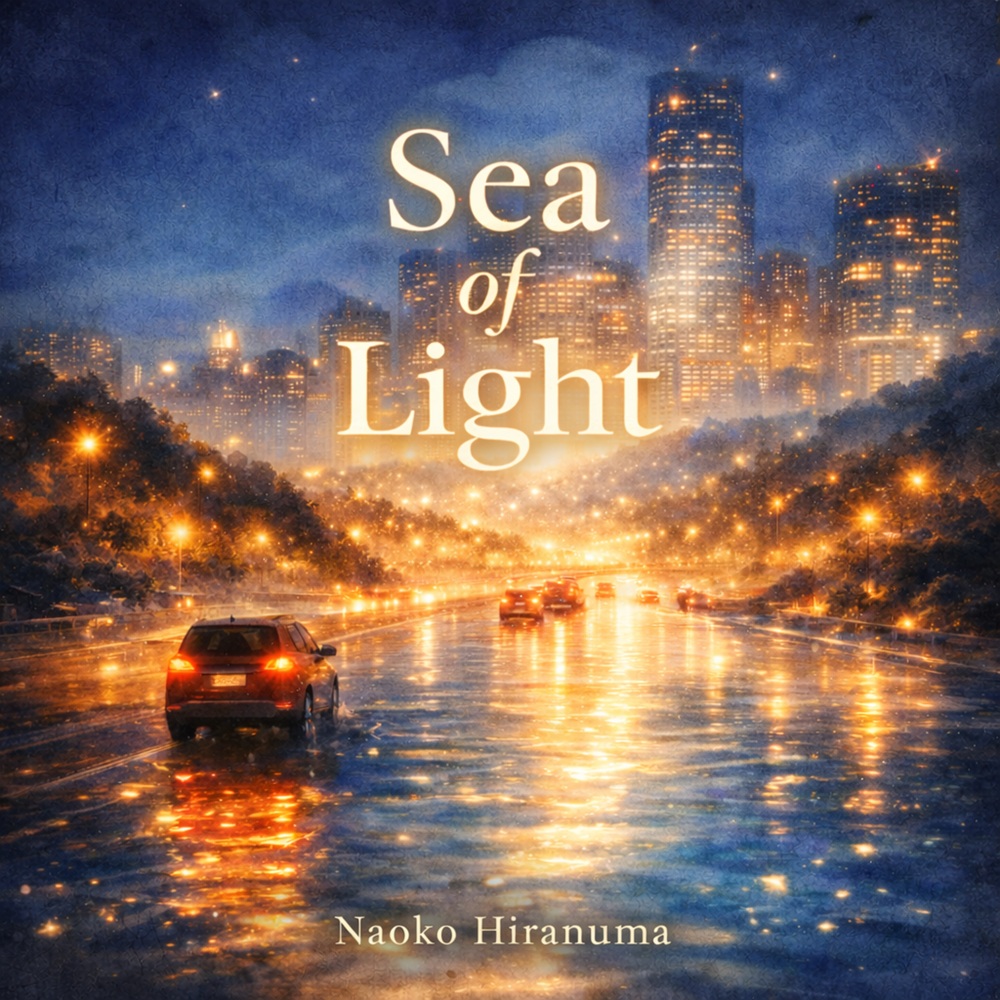
Naoko Hiranuma spent years living by the ocean before music became her full-time focus, working as a diving instructor in Japan, the Maldives, and Fiji before running a surf camp of her own. That connection to the water runs through everything she writes, and “Sea of Light,” out February 5th, folds it directly into the song’s central image: a nighttime drive from the coast into the city, memories of a brief summer romance blurring together with the reflected city lights the way the tide blurs a shoreline.
This song took my breath away. I was actually stunned from the get-go. The way it starts is so perfectly intimate and yet bigger than life; it just completely engulfs you with its emotion like a wave. It’s so powerful, and it’s largely due to Naoko’s incredible vocal delivery and also the powerful and incredibly rich soundscape that supports her.
That wave metaphor fits the song’s own structure well. “Sea of Light” builds gradually rather than all at once, tracking with the press description of a track that unfolds toward an emotional climax rather than front-loading its biggest moment, and the way Hiranuma’s vocal performance grows alongside that build gives the song a real sense of motion, mirroring the night drive at its center. The production stays cinematic without crowding her voice out, leaving enough space that the more intimate opening moments and the fuller, more emotional swell later on both land clearly.
What comes through most is how specific the song stays to its own imagery rather than reaching for something more generic. A romance that fades but leaves its memory glowing, framed literally as a sea of light against a real, remembered drive, gives the song a concrete emotional anchor instead of just gesturing at nostalgia in the abstract. Given Hiranuma’s own history spent so close to the ocean, that specificity reads as lived-in rather than borrowed.
“Sea of Light” is a strong showcase of what cinematic indie folk can do when the imagery driving it actually means something to the person singing it, and Hiranuma’s vocal performance is more than capable of carrying that weight.