



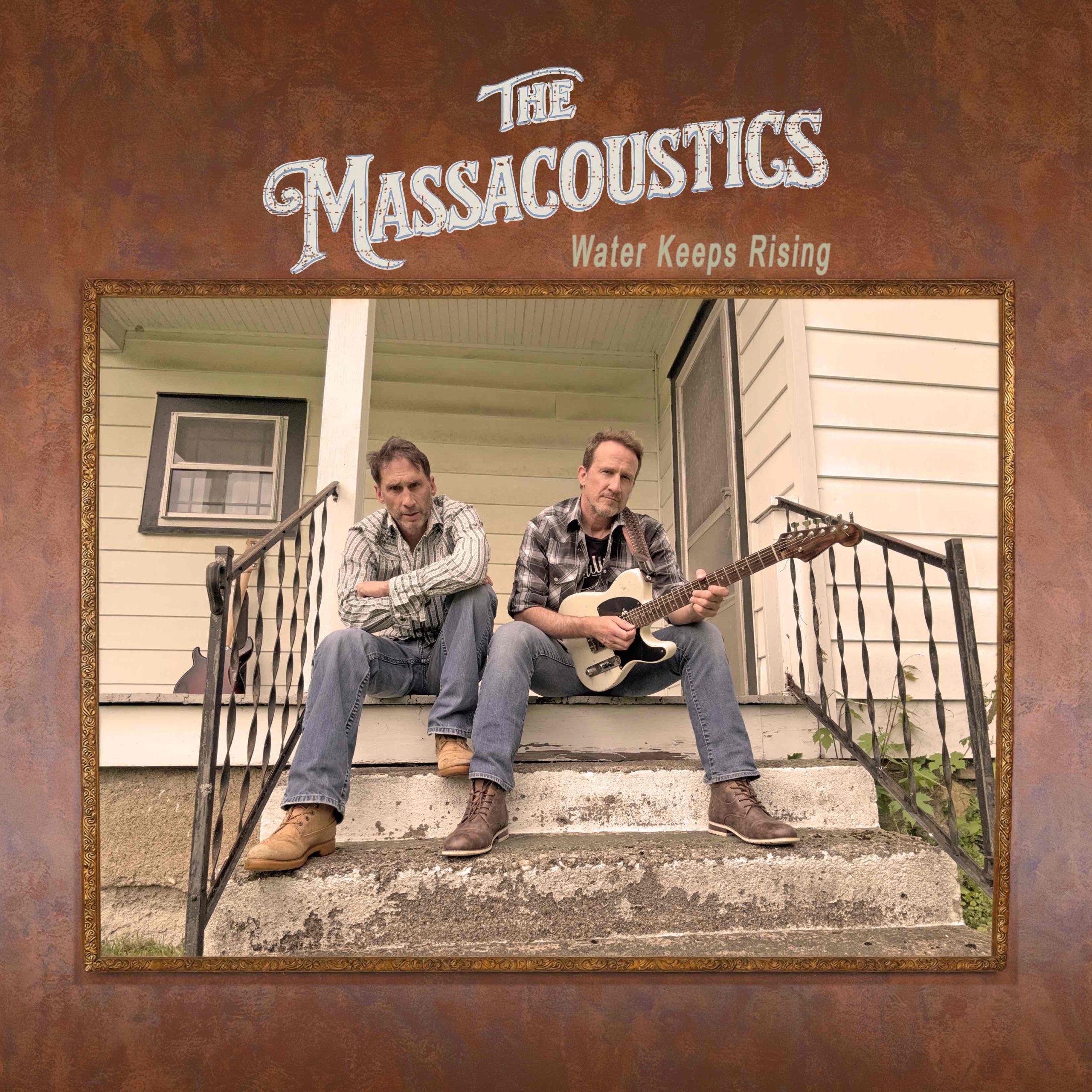
Andrew and Matthew Thompson have been doing this for a long time. As The Thompson Brothers on RCA Records, they toured the US and Europe, shared stages with Willie Nelson, opened for Jerry Jeff Walker, recorded with Steve Earle, Sam Bush, Al Kooper, and Rusty Young of Poco, and played Germany alongside Bill Wyman and the Rhythm Kings. That was in the nineties. Now based between Western Massachusetts and Nashville, they’re operating as The Massacoustics, and Water Keeps Rising is their latest album. Everything on it was recorded live, with Matthew playing drums and bass simultaneously, one-handed, no loops, no backing tracks. Nothing on this record that can’t be reproduced on a stage.
This album feels like a live set, which is among the highest compliments one can give in an era filled with AI-generated music. The band has so much chemistry and flows from one song to the next, telling a completely different story every time, with the power of their dynamics. Mostly since they stick to their trusty Telecaster and acoustic guitars the whole time, you won’t find any experimental synthesizers here or a new song structure that has never been done before. It’s just great writing inspired by real experiences and great execution.
“Train Wreck” is a bold choice to start with because it has the heaviest groove of the whole album, with the stomping breaks highlighting the downbeat and the crunchy guitar tone. It’s definitely a great hook to start with. Not all bands will start with a high note because they might lose listeners later. The band here has a lot of trust, and for good reason, in the other, more intimate songs because of their great songwriting chops.
Speaking of great songwriting, we move on to “Midnight Saving Grace,” which is an incredible display of melodicism and dynamics in terms of musicality. But where it truly shines is the fact that it’s so lean there is no fat to trim. Every single second in the song, every note, is absolutely necessary to tell the story, and that’s something incredibly difficult to achieve, especially when the song has not one but two guitar solos.

“Magnolia Tree” has a timeless anthemic quality to it, and this is a great moment to highlight the lyricism across this album. Using this song as an example: the lyrics tell a love story, how a couple’s first kiss was under the magnolia tree, and then briefly mention that the tree was cut down to make space for a soulless strip mall that sells stuff we don’t need. It’s a simple line, but there is a lot of baggage there because, unfortunately, profit-maximizing ghouls have made our lives worse as they discard nature for their selfish gains.
“Fight For You” is made to be sung by crowds. I can imagine this song being played in a stadium with those lyrics and that nostalgic melody. It would be awesome to witness this live. It leans more towards the country rock genre-wise, but honestly, trying to put it in a box would be doing it a disservice. It’s simply a great song about being there for our friends and loved ones. Is it cheesy? Yes, but we don’t have nearly enough cheese in our lives these days. Everything is masked in irony to the point where nothing feels real anymore, so we need songs like this to balance it out.
“Bottle It Up” is about the other side of that. It’s about the pain that we need our friends to help us with, because it’s bottled up, and sometimes our friends provide an outlet for us to let it out. However, in this song it’s about bottling up itself. The song musically creates that atmosphere by letting the melancholy simmer, and with the second-longest runtime on the album, it really allows one to reflect on the bottled-up pain.
The title track picks the energy back up with its driving beat and hot guitar tone, keeping the momentum going in the face of eternal struggle, which is what the song is about anyway. We are chained to a wall, and the water keeps rising, and the rain never stops, but we keep going, and we dance, and we love anyway, and that’s what makes humanity so amazing. The indomitable human spirit is something we need to never stop believing in.
“Outside The Outsiders” is a narratively simple song about an outsider, but it stands out because of its bluesy melodic sense. The lyrics dig into a feeling most people have experienced but rarely articulate this plainly: being too strange even for the people who pride themselves on being strange, locked out of the laminate-only club by people who judge the shell before the melody. What makes the song resonate is its refusal to wallow. The narrator knows the road less traveled runs twice as long, but keeps the fire going anyway, betting on themselves when nobody else will. It’s a quiet kind of defiance, and the bluesy groove underneath carries exactly the right weight for it.
“Die Easy” has a lyrical hook that cements it as a timeless song: “Work hard, play hard, and die easy.” It’s a well-worn subject in music and art, the urgency of squeezing everything out of a life that doesn’t last, but the Thompson brothers earn their version of it. The hook is so distilled and plainspoken that it lands differently than the usual carpe diem messaging. There’s no grandiosity to it. It sounds like something a wise old man tells you over a drink, and you don’t forget it.
“Nashville” is a gorgeous ballad about missing one’s hometown. Nashville carries special weight here, not just because of the band’s personal history with the city, but because Nashville is essentially the birthplace of country music and the tradition of beautiful, aching ballads that the song itself belongs to. It also plays a structural role in the album’s arc, winding things down gently before the closing track takes over.
“Getting Out” closes the album in beautiful, dramatic fashion with great clean guitar tones, ambient delays, and simple grooves as everything goes sentimental. The lyrics tell the story of someone who has given California, or maybe just the dream it represents, a fair shot, and is now pointing the rental east on I-90 with no illusions left. When false optimism can’t outweigh the doubts, it’s time to get out. The 413 area code reference grounds it in something specific and real, and that specificity is what gives the song its weight. A full return to solid earth, and the album lands exactly there.
Water Keeps Rising is the work of two brothers who have been at this long enough to know exactly what they are and what they’re not, and have made peace with both. There is a lot of road behind these two gentlemen, and there is clearly a whole lotta road ahead.