



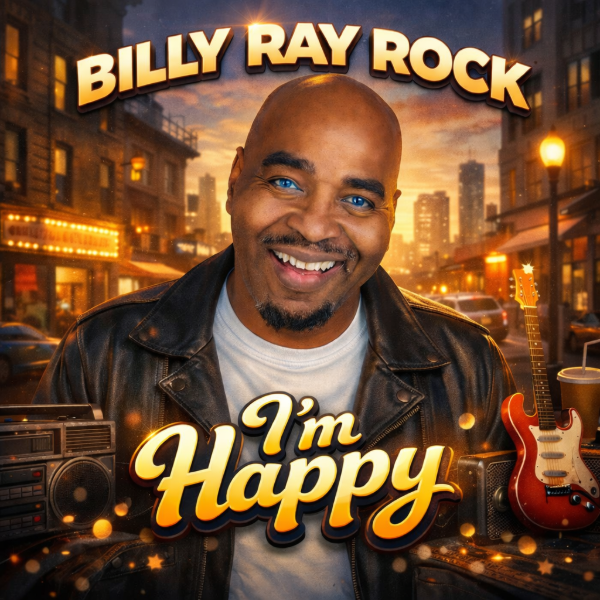
There is a particular courage in writing a song that insists on happiness without disguising vulnerability underneath irony. In contemporary pop and R&B, emotional complexity is often measured by darkness—by how convincingly an artist can narrate heartbreak, anxiety, alienation, or desire. Joy, meanwhile, is treated cautiously, almost suspiciously, as though sincerity itself has become unfashionable. Billy Ray Rock’s “I’m Happy” pushes gently but firmly against that current.
The song does not arrive with grand statements or elaborate emotional architecture. Instead, it unfolds through ordinary details: green lights, paid bills, Friday-night freedom, the release that comes when stress loosens its grip for just a few hours. These moments are small, but Billy Ray Rock understands something essential about popular music: everyday triumphs are often the emotional foundation people build their lives around.
“I’m Happy” moves on a relaxed R&B groove that values rhythm over spectacle. The production is sleek without becoming sterile, balancing modern polish with an almost old-school ease. The beat rolls forward with an inviting looseness, allowing space for the song to breathe. There are no dramatic sonic pivots, no cluttered attempts to force intensity. Instead, the track trusts its own momentum.
That confidence extends into Billy Ray Rock’s vocal performance. He sings with conversational warmth rather than theatrical urgency, and that choice becomes central to the song’s appeal. He sounds present inside the experience he’s describing. His delivery suggests someone narrating a mood in real time rather than performing happiness as a concept.
The chorus is deceptively simple:
“Because I’m happy… it’s something you should know ’cause I feel good, yo…”
In another context, those lines might feel slight. But repetition has always been one of pop music’s most powerful emotional tools. Billy Ray Rock transforms the phrase into something communal—a mantra listeners can step into rather than simply observe. The hook functions less as lyrical poetry than emotional atmosphere. By the time it cycles through again, the listener isn’t analyzing it anymore; they’re inhabiting it.
What makes the song resonate beyond its immediate catchiness is the way it frames happiness not as perfection, but as choice. The lyrics repeatedly acknowledge pressure hovering nearby: stress, drama, negativity, “clouds.” Yet the song refuses to center them. Billy Ray Rock doesn’t deny difficulty; he deprioritizes it. That distinction gives “I’m Happy” emotional texture.
There’s also an understated sensuality woven into the track—not necessarily romantic sensuality, but physical ease. The pleasure of movement. Dancing. Driving. Laughing. Feeling your body relax after carrying tension for too long. The music itself seems designed to encourage release. It invites listeners into rhythm before asking them to process meaning intellectually.
Historically, Black popular music has often carried this dual function: pleasure as survival strategy, groove as emotional restoration. “I’m Happy” quietly participates in that lineage. Beneath its contemporary production and radio-ready structure is a deeper tradition of songs that transform resilience into celebration. The track understands that joy can be practical, grounding, even necessary.
Importantly, Billy Ray Rock never oversells the emotion. There’s no exaggerated triumph here, no attempt to portray happiness as permanent enlightenment. Instead, the song captures something more fleeting and believable: a moment when life aligns just enough to let you breathe easier.
In an era saturated with overstimulation and emotional performance, “I’m Happy” feels refreshingly direct. It doesn’t ask listeners to decode layers of metaphor or unravel complicated self-mythology. It asks them to move, smile, and maybe allow themselves a few minutes of uncomplicated pleasure.
That may sound modest. It is not. In this cultural moment, joy delivered without apology can feel radical.
–Anne Powter