




“Breakthrough moments are often the result of many previous actions, which build up the potential required to unleash a major change. In his book “Atomic Habits,” James Clear stated this. What does that have to do with K-pop? Well, that’s pretty much how most things happen! Nothing just goes boom out of nowhere, and the same applies to K-pop. It didn’t invade the world over night. It has roots that can be traced all the way back to “changga” songs and “trot” music till this very day with BTS conquering the world. And other factors besides the music itself participated in making K-pop a phenomenon.
Whether you’re into K-pop or not, you’ve probably heard of it. “Gangnam style” likely crossed your road, you must have overheard a BTS song, saw a video, or at least glimpsed the name without knowing what it refers to, and if you’re a frequent social media user, then you saw a dancing video or a fan-made video. How did K-pop spread everywhere? Well, let’s begin our adventure into the fascinating realm of K-pop.
Where it all began
In order to discover the truth about something, you have to trace its history. So, it’s story time.
It all began in “South Korea,” a peninsula in East Asia located between China and Japan. Everything was great for more than four thousand years, and then Japan colonized Korea in 1910 and ruled till 1945. Things went worse after that, as the Korean War happened in 1950 until 1953, and Korea was split into North and South. Wars affect everything, including the music industry. Why is it that important to know? Because the root of Korean popular music goes all the way back to 1885, when a missionary named Henry Appenzeller was teaching schoolchildren American and British folk songs, replacing the original English lyrics with Korean ones. These songs are known as “changga.” When Korea was under Japanese authority, it flourished and spread because Koreans used it to convey their feelings, therefore the Japanese banned “Changga” since it alluded to the persecution of Koreans. A new genre, known as the “trot,” has also emerged. It was influenced by Japanese music and has a distinct two-beat rhythm.
The first Korean pop album was in 1925, (“이 풍진 세월” / “The Tumultuous Time,”) by Park Chae-seon and Lee Ryu-saek, which featured popular Japanese songs translated into Korean. Follow it in 1929, the first pop song written by a Korean composer, (“낙화유수” / “Fallen Blossoms on Running Water.”) sung by Lee Jeong-suk.
The Kim Sisters
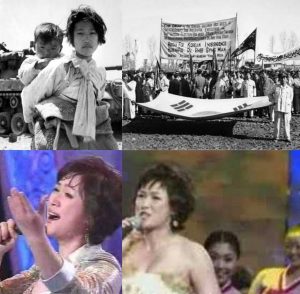
You definitely can’t trace down the K-pop origins without coming across “The Kim Sisters.” In the 1950s, the genre started with The Kim Sisters, a pop trio consisting of Sue (Sook-ja), her sister Ai-ja, and their cousin Mia (Min-ja). Maybe K-pop groups like BTS and Blackpink made their way to the US audience and their music is all over the world, but the Kim Sisters did it first. They achieved huge fame in the US. They sang American hits even before they learnt English, as they sang them phonetically, and they performed on the Ed Sullivan Show more than 22 times. They were very talented as they were multi-instrumentalists and could sing a diverse range of genres.

Seo Taiji and Boys
The 1990s saw the rise of a new era. Thanks to “Seo Taiji and Boys,” they paved the way for K-pop music, and without them, it wouldn’t be the way it’s now. According to music critics, 1992 was the most important year in Korean pop history because “Seo Taiji and Boys” achieved enormous success, created a distinct sound and performance, won awards, and swept genres such as trot, ballad, and folk off the scene. Even though, in previous years, musicians such as “Lee Gwang-jo” sold thousands of copies of their ballad albums. Seo Taiji and Boy introduced a musical blend of hip hop, rap, Europop and techno with choreography. They were the first K-pop group, and with them, the phenomenon of “Idol” culture began. The title song, “I Know,” from their first album, was a breakthrough with its unique choreography, “Tornado Dance,” which went viral. After their fourth album, the group disbanded in 1996. In 2017, Seo Taiji collaborated with the K-pop group “BTS” and held a concert to celebrate his 25th anniversary of his Seo’s debut, and he told them: “Now, it is your generation.”
Following Seo Taiji and Boys, a slew of idol groups arose throughout the years, and to make it simpler to track them down, fandoms divided them into four generations. The first of which began in 1996, shortly after Seo Taiji and Boys disbanded, and the fourth of which includes today’s talents. In the next article, we’ll delve into the diverse talents and get to know each generation and how they enriched the K-Pop industry.