



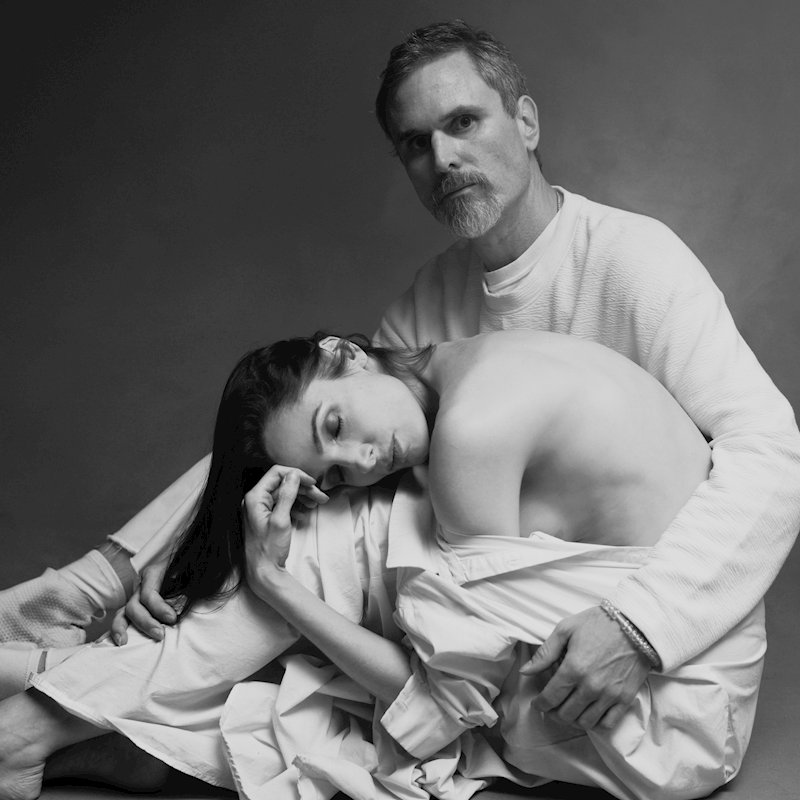
Some creative partnerships feel inevitable in retrospect. Planeswalkers — the new project born from the union of ethereal gothic artist Arden Leigh of Arden & the Wolves and industrial and electro visionary Andrew Means (3TEETH, Patriarchy) — feels exactly like that. Their debut EP “The Mind Room” arrives September 1st, 2026 on all digital platforms: four tracks of dark, immersive witch house exploring ambient, electronic, experimental, and industrial territory that draws comparisons to Massive Attack, Zola Jesus, Portishead, and Imogen Heap. Built on shared occult passions, a synergistic musical chemistry, and a deeply intentional concept rooted in healing, trauma, and the magick of narrative, this is a project unlike anything either artist has created before. We sat down with Arden and Andrew to get inside the world of “The Mind Room.”
- Arden, you had sworn off starting new music projects entirely — yet here you are with a new project and a new name. What specifically did Andrew bring to you in those first few seconds of what became “Horizons” that changed your mind so completely?
Arden: We actually made that decision after the EP was already recorded. I knew I wanted to work with Andrew as soon as he messaged me, but at the time I was doing work with other musicians where we’d each be credited on the songs as separate artists collaborating, or with co-writers who were comfortable releasing under my solo project name Arden & the Wolves. I really didn’t think I had the bandwidth to take on the commitment of another project with its own set of social media accounts and momentum to keep up.
We actually had the album artwork all done up as “Arden & the Wolves + Andrew Means,” and then two months before the release Andrew sat me down and told me that he saw a very strong impression as a psychic medium that if we did it this way, we’d achieve some cult fame, but if we gave the project its own name and image we’d go a lot farther. My own divinations had told me the opposite, but I had been under magickal attack between February and June which had messed with a lot of the answers I was getting. So I went to a third party reader to break the tie, and sure enough, the answer was clear. Before I even finished articulating the question, the reader laid out the cards: Death, Jupiter, Justice, and King of Wands. Literally, “A full transformation will bring great expansion. The correct position is held by Andrew.”
- The name Planeswalkers comes from your shared occult practice of astral projection and planeswalking. For listeners who may be unfamiliar with that world, how does the practice itself — and the shared experience of it — directly shape the music you make together?
Arden: For “The Mind Room,” I had already been working on the situation I wrote the lyrics about, which involved learning and innovating remote communication to answer the cry for help made by a loved one even when they avoided receiving that help in the physical. I used some astral projection, which is typically the practice we think of when we use the term planeswalking, but a lot of it was also accomplished with practices like traditional folk magick, divination, the demon-feeding practice derived from the millennium-old Tibetan Buddhist practice of Chöd, and one archangel summoning from the Heptameron grimoire. I wrote “The Mind Room” vocals about that experience because frankly it was the thing I most needed to work out at the time, because it really was someone’s life on the line, and using the magick of the album as a hypersigil to ensure the success of that work was just an obvious choice to me. I don’t know what else I would have written those songs about. There wasn’t anything I was doing that was more important.
But once we decided to become Planeswalkers, the practice became woven into who we are as a band. For our following song, “Great Big Blue” which dropped on September 15th, I decided to give myself a break from the heaviness of the trauma healing work and use the lyrics to manifest some of the future travel that’s been predicted for me instead. But even in that, we wrote Andrew a spoken part in the bridge where he plays the captain making a flight announcement predicting no astral interference by negative entities, so it brings what could have otherwise been a very materialistic song back into our world. Plus that line in the song also serves as an added layer of protection and clearing.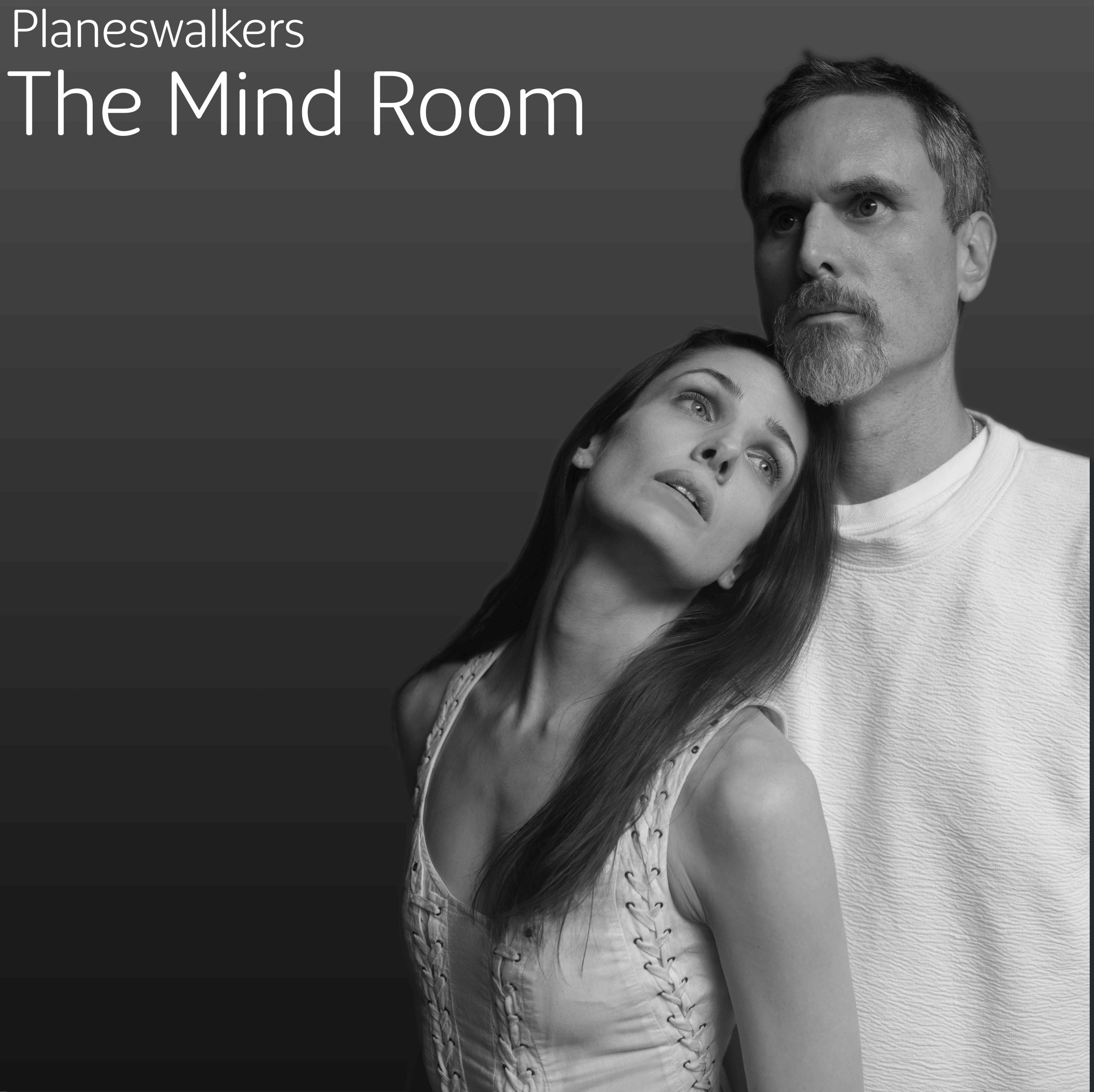
- “The Mind Room” is built around the concept of the hypersigil — a work of magick that alters reality through narrative and intent, a term from your teacher Grant Morrison. How consciously did you construct the EP as a working hypersigil, and what was the specific intention you were charging into fruition through writing and singing these songs?
Arden: Oh at this point I assume everything I sing has a strong chance of coming true, often in ways I don’t necessarily expect. It would be irresponsible of me not to acknowledge the consistency of that pattern. “The Mind Room” was one hundred percent a conscious hypersigil on my part. Although at that point on the timeline, really the narrative of the first three tracks had unfolded already since I had already been doing the remote communication I sing about in track 3, “Body.” So what the EP did was organize the existing work into a clear narrative in the first three songs, and then ensure the success of that work in the last track, “Alive.” And that was the intention, to make sure that the work was successful and that my friend made it out alive.
- The EP explores facilitating healing from extreme trauma through remote means — navigating tripwires in the psyche, creating safety among internal parts, and building the trust needed to begin unpacking deeply buried memories. That’s an extraordinarily complex and delicate subject. What responsibility did you feel in translating that process into a dramatized musical narrative — and how did you ensure the music honored rather than sensationalized it?
Arden: I felt a responsibility to keep my friend alive when I was the only one in their life who understood what was happening with them. I don’t want to be a dick to anyone either  but that was my priority. It’s not really in my nature to be especially maudlin or emotionally indulgent in my writing. It felt necessary to keep these songs abstract for the same reason that the trauma itself needs to be approached delicately. There’s a card from Brian Eno’s oracle deck Oblique Strategies that I kept pulling during this time: “In total darkness or in a very large room, very quietly.” I actually wanted to title the EP that at one point. The form has to match the content, you know?
During the process itself I went quiet and isolated myself from everyone for a long period of time, save for a very small circle of fellow practitioners, because there really is just nothing you can say about it and almost nobody who can relate to you. Nobody’s going to understand what you’re doing, everyone thinks you’re nuts. Even the archangel I summoned thought I was out of my mind caping for someone who had been so toxic to me until I explained to her that those behaviors were symptoms of trauma, showed her the treatment map I’d laid out, and asked her if God’s forgiveness was not for everyone or if there were any among His children who were excluded from the Kingdom of Heaven. There’s a certain mutism that holding that much grief and horror induces. You just don’t respond to those conditions with sensationalism. You stay the course and you do what’s necessary to get the job done, and you kinda have to not care what anyone else thinks about it.
I was worried about “Body” giving a wrong impression since it’s personal to the situation and does not describe an approach I would generally recommend in treating dissociative identity disorder. And importantly, I referred the person to a qualified lived experience professional for treatment – I just needed to do the remote communication to get them to actually go. In reality I approached it a lot more gently than is expressed in the song, even remotely – but at the same time, there were certain things that needed to be said, posthumously, and the song was the right place to say them.
I ran the EP and the press release by Katie Keech, who’s a plural lived experience clinician specializing in treating extreme trauma, and by another similar colleague of theirs in the UK who goes by Mouse (Chris Maskens professionally), for their seal of approval before releasing it. Generously, they seemed more concerned about the subject matter landing me on a watchlist.
- Andrew, you approached Arden with four tracks in late 2025. What was the sonic world you had already built before she arrived — and how dramatically did her vocals, melody, and lyrical vision transform what those tracks became?
Andrew: I had meditated on a beautifully rich sonic world beforehand, but Arden brought color to it. It had been sonically sepia before and the vocals really set the tone for the whole project. The tracks became something significant after the vocals were added.
- The four tracks — “Horizons”, “Clockwork”, “Body”, and “Alive” — move through the witch house and ambient electronic landscape in a very specific sequence. Is there a narrative arc the listener is meant to follow from beginning to end, and how did the track order reveal itself?
Arden: That was the order of the tracks when Andrew sent them to me, and even though I don’t think it was purposeful, I just started hearing the story that way. Absolutely there is a narrative that runs from beginning to end.
I actually briefly wanted to name the tracks after the four stages of Stanislav Grof’s Basic Perinatal Matrices but Andrew thought it was better to pull titles from the lyrics, and I think he was right about that.
- Arden, Alternative Nation has praised your voice as having the potential to carry a torch to higher levels than even the most celebrated female lead singers in alternative music. Andrew, you’ve worked in the world of 3TEETH and Patriarchy. How do two artists with such distinct and established sonic identities find a sound that genuinely belongs to neither of them alone — but fully to both?
Andrew: That’s a great question. I think it has more to do with the conceptual definition and the overall aesthetic composition of the groups that when paired with specific sonic pallets gives the impression that the sound is uniquely theirs.
Arden: I am always looking to challenge myself by working with different people. I like adapting to other people’s styles as a means of growing myself as an artist. Truth be told, I’m so much more comfortable vocally in a pop belter Pat Benatar register, but the delicacy and precision of Andrew’s tracks and of the subject material called for a different sound, and I was eager to prove I could hang.
I think that Andrew’s and my shared lightwork practice informs our work together going forward so there’s a common thematic ground to return to. But I’m also interested in continuing to challenge myself vocally. “Body” was the first rap I’ve released, “Great Big Blue” is in a sort of chill glottal fry style rap that I’d never done before, and I’m working on writing some screams into my next topline.
- You’ve recommended The Plural Association at powertotheplurals.com as a resource connected to the themes of this EP. How important is it to you that the release carries that outward-facing responsibility — and do you see Planeswalkers as a project with an ongoing social or healing mission beyond the music itself?
Arden: When I ran the EP by Katie Keech she suggested that was one thing I could add to the press release that could offer a positive impact. I really like that organization; I’ve attended some of their online conferences, so I owe them credit for the education they helped me acquire leading up to the work that would eventually be documented in “The Mind Room.”
I think Planeswalkers by nature has a mission of lightwork in the world. When you work with angels as much as Andrew and I do, it kind of becomes implicit. I don’t think it has to be all that deep, either – it’s just us presenting our spiritual experiences and relationships without apology. I think we’d like for everyone to know that those same skills and relationships are available to them if they want. Andrew began developing his clairaudience during the pandemic by tuning out all noise and music and engaging in ten hours of sensory deprivation per day. I developed my skills by divining and doing magick every day. We would be so happy if there were people out there who decided to train their gifts, develop relationships with angels, or expand their consciousness because our music helped them to see that it can be done. I guarantee there are people reading this right now who have spirits on the other side who are just waiting for them to make contact and ask for assistance.
- Andrew has said he is ecstatic about how the lyricism and musical expression go hand in hand — and Arden, you’ve expressed excitement about continuing to explore both music and magick together. What does the future of Planeswalkers look like — and is there already more music, or a larger body of work, beginning to take shape in the netherworlds?
Arden: Aside from “Great Big Blue,” we have a cover song picked out for the future, and we’re working on developing more originals. Andrew sent me seven more tracks to topline and they’re all brilliant but unfortunately I work a lot slower than he does. I have ideas brewing, but when all your songs have a habit of coming true, and the landscapes of the times keep changing, you tend to get very intentional about what you write. I’m working on it though!