



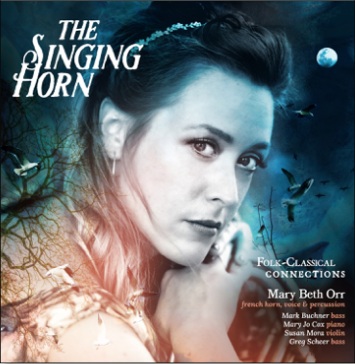
Very few artists begin their path with their magnum opus. Mary Beth Orr might just belong on this short list with the recent release of her The Singing Horn, a 26-track project combining classical horn and folk music. You might be able to see only a slight exaggeration in this statement; though this is her first released album, Mary Beth Orr is not really just beginning her career.
A classical hornist, Orr is currently 3rd Horn of the Grand Rapids Symphony, with award-winning solo performances and frequent appearances in the Detroit Symphony, Charleston Symphony, and Breckenridge Music Festival, of which she is 2nd Horn. Her career went beyond America in 2021 where, as a first prize winner of the Grand Prize Virtuoso Competition, she made her European premiere at the Beethoven Haus in Bonn, Germany.
Between 2020 and 2022, she was a multi-prize winner of the Sound Espressivo International Music Competition, and 1st prize winner of the Golden Classical International Music Awards, American Protégé International Talent Competition, and the Charleston International Solo Competition 2021, where she was also voted most outstanding performance. That is to say, Orr has already led a pretty impressive career. Yet, The Singing Horn is something else altogether.
Beyond classical horn, Orr is also adept at the piano, with a third powerful instrument: her voice, particularly her folk vocals. A lover of folk music, a classical musician, and a woman raised in the rich tradition of Appalachian music, Orr’s unique mix of influences, talents, and passions is best expressed in her first album. Released earlier this year in March, The Singing Horn sees Orr open the doors of separate categories onto each other, allowing a fluid movement and creation that trespasses what we regularly mean when we say genre fusion. Not least because, unlike other instruments like the piano and the violin, the horn has not really had its moment in the sun outside of orchestral performances and classical music.
Different divisions can guide you across the album. The first six tracks, beginning with “Appalachia and Wayfaring Stranger” and ending with “Songs of the Wayfarer: IV. “The Two Blue Eyes of My Sweetheart” function best together as one song cycle, finding a prologue in the first track and their coda or epilogue in the sixth track, “Oh Death”.
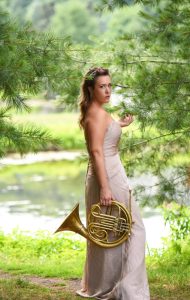
The first track, composed by Lydia Busler, introduces us to the horn, with a solo that lasts for 5 minutes of the 7, easily, perhaps surprisingly, giving way to Orr’s stunning rendition of The Wayfaring Stranger. Otherwise, only a subtle bass runs through the track. The part of the song covering the Wayfaring Stranger is itself simple, without subversive moves, or too unique an adaptation as others have done. The cover itself is barely even set to any music. This simplicity, however, creates a striking effect where the original gravitas of the song is crystallized with Orr’s clean vocals. The horn solo is likewise traditional, serious, and grandiose.
A great musical experience in its own right, this track is also, clearly and for the reasons already mentioned, Orr’s thesis statement with the album. She combines the classical horn, in a traditional composition and performance, with one of the oldest hallmarks of American folk music in the first track to clearly and succinctly show us that those divisions and lines we’ve created between the refined, Academic classical music precisely created and between our imagined most authentic type of music, folk, that didn’t originate in any particular artist but from the land itself aren’t as hardy and unbendable as thought to be. The song features a smooth transition from one to the other, but without any overlappings, exactly to show that once put side-to-side those lines already start to blur. And that if we look a little too closely, those categories start to fall apart.
The following four tracks in the cycle are renditions of Gustav Mahler’s song cycle Lieder eines fahrenden Gesellen (Songs of a Wayfarer), originally written with sung words and performed with piano accompaniments. Rearranged by Michael Drennan, Orr’s rendition heavily uses the French horn, creating a very distinctive but still recognizable version. Otherwise, Mahler’s cyclicality is kept intact, telling the story of an unrequited love, loss, and eventual peace. Adding the French horn and using America’s Wayfarer as a pretext to Mahler’s shows Orr’s ability to find and carve surprising connections.
The cycle culminates with “Oh Death”, a traditional Appalachian song, returning to folk music, which inserts Mahler’s cycle within a different, larger cycle that Orr creates. Embedding the German composer’s classical songs between American folk music shows the possibilities of an interaction between the two categories.
The seventh track, “Wondrous Love” is a more complex break after the cycle. A traditional folk hymn, Orr’s rendition sees for the first time in the album an interaction between the French horn, violin, and bass all together. Because it is still a common hymn in many Christian denominations, the French horn’s presence is even more striking than usual. As with the other tracks, it allows us to hear a traditional, familiar composition in an entirely new way.
The 8th track up to the 22nd features Orr’s work for Robert Voisey’s Fifteen Minutes of Fame Project, done with compositions that were created specifically for Orr in an edition titled “Heroines”. The diversity of the compositions, coming with different inspirations and for different composers, allow for a much different experience from the cohesiveness of the first six tracks. Without uniform unity, this section instead allows for a sense of fluidity that is difficult to resist as a listener. Though its connection to the first section of the album is less strong than one might have wished it to be and itself internally smoother at points than others, the overall experience remains a positive one.
One of the most touching tracks on the album is “Good and True”, an intimate portrayal of motherhood that is at once soft and strong, where Orr’s vocals are at their most ethereal and where the guitar makes its only appearance. Composed by Orr herself, the melody has a hint of a childhood lullaby, marking it a fitting penultimate track.
Better thought of as a spatial landscape than a linear, cohesive progression of tracks, The Singing Horn is made up of diverse moments that you can seek and linger in, finding a metaphorical spot under the shade, or by the river. The Singing Horn is a grandiose, ambitious project that succeeds in its aim to prove that classical music at large, and the French horn in particular, can be put together with folk music (and potentially, any other genre) and deserves a spot on the same table without unnecessary divisions.