



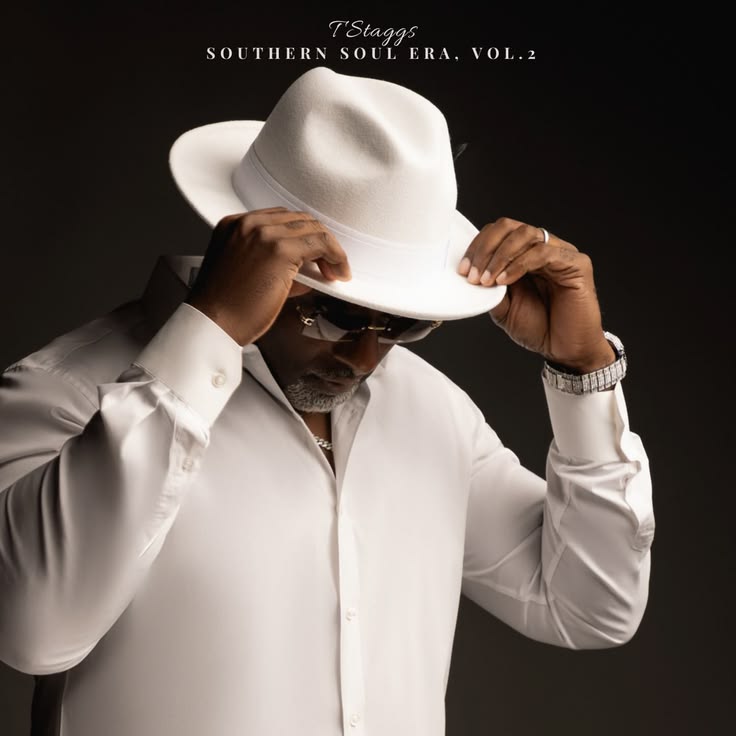
He was raised in the church in Spartanburg, South Carolina, became known locally as “The Wedding Singer”, and has spent his life turning personal faith, love, and resilience into music that moves people. T Staggs is back with “Southern Soul Era, Vol 2” — out now on all digital platforms — and it is everything the title promises: warm, groove-laden, gospel-infused Southern soul that carries the spirit of Bobby Womack, Al Green, Luther Vandross, and Curtis Mayfield into the present day. Eight tracks built on humility, self-belief, and the unwavering conviction that music should make people feel good. We sat down with T Staggs to talk about the album, the journey, and the soul at the center of it all.
- You live by the phrase “I aspire to Inspire.” When did that become your guiding principle — and how does it shape every creative decision you make?
Honestly, I came up with this phrase one day while I was in the gym working out a couple of years ago. I would take pics or videos of myself working out and I would then post them on social media. The results of my hard work were paying off. People began to hit me up asking me, “what I was doing to get the results I was getting”. Then one day it hit me, you are inspiring people to take care of themselves physically. So, I then began to post with the caption “I aspire to inspire”. In other words, let my work and results motivate you to become a better version of you. Now with everything I do, I say to myself, will this inspire someone else to be better.
- “Southern Soul Era, Vol 2” opens with “Fight For You” — a track that immediately feels like a classic. When a song comes together that naturally, what does that creative moment feel like, and how quickly did you know you had something special?
From the first time I heard the reference track, I knew at that moment, this song had that it factor. You know there is a stigma within the R&B community that says artists are not making real R&B music anymore. I heard them say that the element of singing directly to your love is missing. Telling her how you really feel is gone. The title “Fight For You” within itself speaks volumes meaning I value the relationship so much so that I’m willing to whatever it takes to keep it going. To even have the notion of splitting up is a no no. The first verse in this song says, “Girl I know you been sick and tired of fighting this good fight”. That’s heavy there. All relationships go through times in that relationship where you are just fed up with each other, you are mentally and physically drained. But then the love that you both have for one another is just so overpowering that it causes both of you to continue to fight for the relationship. It’s life. This song details all the emotions. From a singing standpoint, you can since my tone in every word I sing. I mean what I’m singing PERIOD!!
- “Hey Hater” is a standout — a gospel-drenched, organ-driven meditation on sending love even to those who wish to tear you down. In a world where that kind of grace is increasingly rare, where does that spirit come from in you personally?
I was raised right. My mom and dad did a good job with my sister, my brother and myself. We were never taught to hate. To elaborate even further, I’ve always been a nonchalant type of person. I don’t care what you think of me, you can’t stop me. If I have the ability to do something, I’m going to do it. It’s just that simple. I love this song. Honestly, this song needs to be the worldwide Anthem type because for the most part all of us have some haters in some aspect. Like the song says, you have some loud ones, and you have some quiet ones. Some folks just hate who you are. It shouldn’t be that way but that’s the world we live in. It’s been like that since the beginning of time.
- You grew up in the church in Spartanburg, SC, and that foundation is unmistakable throughout this album. How much of your gospel upbringing consciously informs your approach to R&B and soul — and how much of it just lives in you naturally at this point?
Well, if you do your research, most of the great R&B and Soul singers grew up singing gospel music in the church. Gospel music is about feeling, soul, and rhythm. Gospel music touches your soul like no other genre of music I feel so for those traits to spill over into the genre of R&B and soul, it’s a given, its natural, it’s not manufactured, it’s who you are, it’s how you live, ITS YOU!
- Which tracks on “Southern Soul Era, Vol 2” are the closest to your heart — and why?
 Of course the track “Still Here” is dear to my heart because its about my dad whom I lost in October of 2024. My dad was in my life all my life. I’ve never known life without my dad so now navigating through life now without him is tough. My dad was in the Army, when I was a kid, every summer he used to go away for summer camp for 2 to 3 weeks and every time he would leave, I would get sick. I guess it was separation anxiety. The only difference is back then I knew he was coming back and now he isn’t. So now I just try to remember all the things he taught and just keep striving to be all I can be. Another track that’s dear to my heart is “Miss Those Days” because it takes me down memory lane of growing up. I grew up in a family orientated rural country neighborhood named “SHILOH”. So growing up my cousins were my closest friends. Some of the things we did were crazy, but I wouldn’t trade those times for nothing in the world. This song captures some of those moments. I’m also really digging the track “Pop My Ishh”. Some might consider this track as a song where I’m boasting and bragging when that’s far from the truth, every lyric on this record is 100% fact. I said all that in the song to basically say, I’m handling my responsibilities as a man from being a husband first and a father second and this is what I plan on doing for the rest of my life. To add a little more context, my life hasn’t always been taking trips to different islands per se, I’ve survived many tough seasons in my life, seasons where I was like “God what is happening here”. But I kept my head up because I knew it don’t rain always, at some point the Sun must shine. So, with that being said, I will forever be thankful. I know where all my blessings come from, God Almighty. Another record I love on this project also is “Strung Out”, the concept where sing and music is the love of my life. I don’t want to go into much detail right now, go listen to this track and let me know what you think. It’s very creative. I guarantee you will love this track.
- R&B and Hip-Hop today are largely defined by their commercial shape — trap influences, streaming-optimized sounds, viral moments. You’ve chosen a very different path rooted in classic soul. Isn’t that a risk when it comes to gaining new listeners or mainstream visibility — and does that concern you at all?
I’m not concerned at all because I’m staying true to myself. I’m not chasing anything. I’m of the belief that there is an audience out there for my type of music. What’s life without taking risk? I’m a huge risk taker. I like traveling down the road less traveled. I don’t follow trends. I follow my desires and passions. I also think people get tired of the same old thing. You can never go wrong being true to you. God created you to be different. Why cheat God out of his creative genius trying to be like the next person. Be you, do you, love you.
- You co-produced this album alongside Days on 85. What does that creative partnership look like in practice — and how do the two of you find the balance between the classic soul foundation and keeping the sound fresh?
Days is my lil cousin with so much talent. I was on a podcast a couple of weeks ago and the host asked me how long it took us to create Southern Soul Era, Vol 2, and I told him we recorded the entire album in about 9hrs or so. Days live in Atlanta and he drove up to Spartanburg SC one Friday night. He got to my house about 9:30pm and we recorded until about 1:30am. He came back Saturday morning around 10am and we finished the entire album by 3pm that afternoon. This is our 3 album we have worked on together so over time he understands me, my strengths and my weaknesses and how I like to record. We bounce ideas off each other and I have freedom to do whatever while recording. If we both feel it, it’s on the record, if not, we keep it moving. That’s my guy. Again, he is a song writer and music producer, and he is around all kinds of artist while living in Atlanta. He is in many studio sessions with well-known artists so for me to even be able to still have access to him is amazing.
- The album spans a wide emotional range — from the sensual groove of “Step With Me” to the explosive James Brown energy of “That Feeling” to the quiet strength of “Still Here.” How did you approach sequencing these eight tracks into one cohesive listen?
With each song having its own emotional exuberance and identity actually it was very easy to sequence it all into one cohesive listen. Of course, we communicate on the placement of each song on the album. It’s about a flow meaning how one song leads into the next song. The following song must compliment the prior song. But again although I titled the album “Southern Soul Era”, you can definitely hear different R&B style concepts in the songs.
- You were known for years as “The Wedding Singer” before stepping fully into your recording career. What do you think that experience of singing for people at some of the most emotional moments of their lives taught you about connecting with an audience?
Deep question. First off it allowed me to gain even more confidence in my craft. Singing in front of hundreds of people and all eyes are on you, that can be very damaging if you are not prepared and ready. But good thing is, I thrive in those type moments. God bless me with a gift. I think one of the main things it taught me was don’t take the audience ear for granted. Each ear is precious so handle it with care. It also taught me that eye contact is very important as well when you are performing because it allows the audience to not only listen to your voice but also look into your soul so to speak. It allows them to feel your passion for what you are doing.
- Your number one fan is your two-year-old granddaughter — who already knows and sings all your songs. What does it mean to you to have your music living inside your own family like that?
That’s the greatest feeling in the world. Really unexplainable. When I say she knows the songs, she knows all the songs, it’s remarkable. I hope it sparks something is her to where she becomes a singer. She already has the desire and mannerisms as well.
- Are there any plans for a Vol 3 — and if so, is there a direction or theme already forming in your mind?
Yes, already in the plans. I think we going to continue in the same vein as we started on Vol 1 going into Vol 2. More soul, more rhythm, more blues. I’m aiming for Vol 3 to be out sometime this year.
- Any music videos planned to bring some of these tracks to life visually?
So currently I have visuals for “Still Here” and “Hey Hater”. I plan to do more visuals for a couple more tracks as well.
- In such an AI-driven era, how do you see the future of indie artists in particular — and the music industry in general?
Music industry has definitely changed. I’m not really a fan of the AI driven era. To me it’s not real and it’s not authentic, its too perfect and that’s the problem. Perfection doesn’t exist.
- You’ve said the goal from the start was to create relatable content — and that you believe you nailed it with this album. For someone who hasn’t heard a single T Staggs song yet, what do you want them to feel the moment they press play — and where would you send them first?
I want them to hear a sound they have never heard before. As they listen from the first note sung, I want them to not only hear the passion but to feel the passion. I want them to say “who is that and where has he been?” lol All the songs are fire if I must say so myself but if I had to choose one song to send them to first, I would send them straight to the first song “Fight For You” because this song sets the tone for the entire album.